
The trailer came up the last switchback of Nottingham Ridge just as the light was going purple, the F-250 groaning under a load it hadn’t been built for. Joy heard it before she saw it — that particular rattle of a hitch that had been seized with rust an hour ago — and she was already at the barn doors when the headlights swept across the yard.
Eli came out behind her, slower, wiping his hands on a rag he didn’t need. “That’s not the trailer that left.”
“Nothing’s the trailer that left,” Joy said. “Look at the paint.”
It rolled to a stop and for a second nobody got out. Then Bill’s door opened and he half-fell out of the cab, one eyebrow noticeably shorter than the other, smelling like a campfire that had made bad decisions.
“We’re alive,” he announced, like that settled everything.
“You’re singed,” Joy said.
“I’m alive and singed. Two things can be true.”
Brett came around from the driver’s side already unhooking the tie-downs, and Dave climbed down last, cradling something in his lap the whole ride that he still hadn’t let go of — a repeater chassis, dark and dead, held the way a man holds something he’s not ready to admit is broken.
They walked the trailer in the fading light. Twelve solar panels, lashed down crooked but intact, one corner frame bent where it had taken a bad angle coming off the roof. The Wheatstone console, scorched black along one edge, knobs melted to nubs on the side that had been closest to the fire. The FTDX101D and the IC-7300, wrapped in a moving blanket like something precious, which they were. The BW150 transmitter in three pieces instead of one, because there hadn’t been time for it to come apart any other way.
Eli walked the length of it twice, the way he’d walked the Vault twice that morning, cataloguing instead of commenting. Joy watched his face instead of the gear.
“Where’s the battery rack,” she said.
Nobody answered right away. Dave finally looked up from the repeater in his lap. “It’s still in the floor. Wired into the joists. We didn’t have thirty seconds, let alone the time it would’ve taken to cut it free.”
“It’s a hole in the ground with a very expensive campfire in it now,” Bill said, quieter than his earlier joke. “That one’s on me.”
Joy didn’t yell. That wasn’t her way. She just stood very still for a second, doing the math the same way she’d counted the hand-crank radios that morning — not because the number would change, but because saying it out loud made it real. “Tell me everything. From when Brett came up the drive too fast.”
So they told her. The direction-finder agent walking his slow circles through town like he was dowsing for water. The checkpoint on the way out of the U-Haul lot, and the three seconds Brett spent deciding whether a lie would hold. The frantic strip-down of the shack, panels off the roof mounts bolt by stripped bolt, the console carried out sideways because there hadn’t been time to carry it any other way. And then the WVO tank, the Ameritron’s hot terminal sitting two feet from where Bill had decided, with ten seconds to decide anything, that draining a hundred pounds of biodiesel-adjacent fuel right there was a good idea.
“In my defense,” Bill said, “nothing about that decision felt slow at the time.”
“You set the transmitter shack on fire,” Joy said.
“I contained the transmitter shack’s fire. To itself. Mostly.”
Eli, who had been quiet through all of it, finally spoke. “So. We have a transmitter with no home. A console that half-works. Two working radios. Twelve panels.” He nodded once, like he was closing a ledger. “And nothing to store a single watt any of it makes after the sun goes down.”
That was the sentence that landed. Joy exhaled slowly. “Holy shit.”
“That’s about the size of it,” Dave said.
They laid it out on the workbench inside the Vault like a crime scene — which, Bill pointed out, it kind of was, since the crime was his. Dave did the talking, because Dave was the one who’d actually run the numbers on the drive back, scribbling on the back of a topo map by penlight.
“Here’s the problem in real terms,” Dave said. “The FTDX101D pulls maybe an amp and a half sitting there listening. The second we key up and transmit at anything close to a hundred watts, that jumps to twenty, twenty-two amps. The console’s not huge on its own, but it’s not nothing, and if we ever want this thing doing more than emergency bursts — actual broadcast hours, reaching La Crosse the way we’ve been talking about — we’re not looking at one battery. We’re looking at a bank. Hundreds of amp-hours, easy, just to get through a broadcast and a cloudy stretch without the whole thing going dark.”
“In English,” Bill said.
“In English: we need a lot of batteries, and they need to be the right kind. Starting batteries — the kind that crank a car — are garbage for this. Thin plates, built for one big burst, they die fast if you draw them down slow and steady the way a radio station does all night. We need deep-cycle. Thick plates, built to get drained and charged back up hundreds of times without falling apart.”
“And where does a deep-cycle battery live, if it’s not under the hood of somebody’s truck,” Eli said. Not really a question.
“Boats,” Dave said. “RVs. Anything that ran house power off a battery bank separate from the engine. Sealed AGM if we’re lucky — no acid to spill, survives sitting dead for months better than the old flooded kind. Group 27s, Group 31s if we’re greedy. 8Ds if God loves us, though those things weigh better than a hundred and thirty pounds each and somebody’s carrying that out on their back.”
Joy spread the map Dave had scribbled on across the bench. “So where.”
“Genoa’s closest,” Bill said. “Lock and Dam’s right there, twenty miles on one road, no detour through anything bigger. Small town, small boats. Not much of a haul, but it’s close and it’s quiet.”
“De Soto’s about the same distance the other way,” Dave added. “Similar size. Similar odds.”
“Stoddard’s the real one.” Brett tapped the map where Dave had circled it. “Actual marina. Actual slips. That’s where the volume is — more boats in one place means more chances at an 8D bank instead of one tired Group 27.”
“And La Crosse,” Eli said, “has the dealer. The one that services these things. That’s your motherlode, if it comes to that.”
“It’s also DHS’s front yard,” Joy said. “We don’t walk into that unless Stoddard doesn’t get us there.”
They sat with that a moment — the size of what they were about to ask of each other, weighed against the size of the hole they were trying to fill.
“I’ll run Genoa first thing tomorrow,” Bill said. “Alone, fast, no armor, no fuss. See what’s actually sitting there before anybody commits to anything bigger. If it’s nothing, it cost us half a day. If it’s something, it buys us time to plan Stoddard right.”
Nobody argued with that. It was, everyone silently agreed, the first sensible thing Bill had proposed all day.
He was back before noon, and the something he found fit in one hand.
“One Group 27,” Bill said, setting it on the bench like an apology. “Resting at twelve-point-one volts. She’ll take a charge, but she’s not carrying a broadcast on her own, and she sure isn’t carrying twelve of them.”
Dave checked it with the multimeter anyway, out of habit more than hope. “It’s not nothing. It’s just not enough.”
“Then we go to Stoddard,” Brett said. It wasn’t a question this time either.
Joy looked at the two of them for a long moment — Bill still smelling faintly of smoke, Brett already checking the sling on the shotgun he hadn’t put down since the drive home. “Then you go loaded. Both of you. I’m not doing this conversation twice in one week.”
The pole barn smelled like cut hay and gun oil, which Bill had always found to be an underrated combination.
Brett was already at the bench, field-stripping the AR-15 Takedown with the mechanical patience of a man who’d done it a thousand times in worse light. He didn’t look up. “You good?”
“I’m one eyebrow short of good,” Bill said, “but I’ll take what I can get.”
They pulled the Vault’s doors open together, the biodiesel ambulance ticking as it cooled from a trip it hadn’t taken yet. Racked along the back wall: plate carriers, the ceramic scarred but rated. Brett handed Bill a set without asking if he wanted it — that had never been a question between them. Bill checked the Glock 43X riding in his waistband, dropped the mag, thumbed it full, seated it home. Brett snapped the rifle back together and pressed it into Bill’s hands, then slung a shotgun across his chest and his own carbine across his back, because Brett had never in his life believed one gun was enough guns.
“Radios,” Bill said.
“146.520,” Brett confirmed, clipping the handheld to his vest. “Dave’s monitoring. Twenty minutes dark, he assumes the worst.”
“He always assumes the worst.”
“He’s been right the last four times.”
Bill didn’t have an answer for that. He just climbed into the truck.
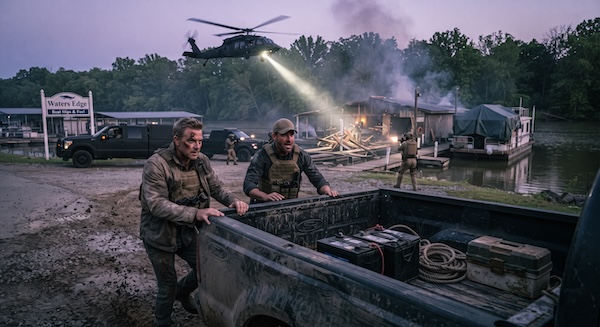
Waters Edge, the marina outside Stoddard, sat exactly where the map said it would, seven miles south of a city they weren’t going anywhere near — a strip of docks and houseboats along the Mississippi, the motel behind it dark and long-since looted, but the marina itself looked wrong. Looked tended. A tarp stretched too neatly over one hull. Smoke, thin and careful, rising from a fire pit someone had bothered to shield from view.
Somebody was living here.
“Company,” Brett said quietly, easing the truck to a stop in the tree line.
They came out of the boathouse before Bill and Brett had even gotten the doors open — four of them, lean and hard-eyed in the particular way of people who’d survived this long by not trusting anyone who showed up with a truck. The one in front had a break-action shotgun held low but ready.
“This is ours,” the man said. No greeting. No wasted words. “Whatever you’re here for, it’s ours.”
Bill kept his hands loose and visible, the universal language of a man who’d rather talk than shoot. “We’re not here for you. We’re not here for your food, your fuel, none of it. We need batteries. The deep-cycles off the boats. That’s it.”
“Those batteries run our pumps. Our lights.” The man’s jaw was tight. “You want to talk about need, we’ll talk about need.”
“There’s more boats here than you’re using,” Brett said, and it wasn’t a threat, just a fact laid flat on the table.
It didn’t matter. Bill saw it in the man’s shoulders half a second before it happened — the shift, the decision already made before anyone had finished a sentence. The shotgun came up.
“Down!” Bill was already moving, hauling Brett sideways by the vest as the blast tore through the space where they’d been standing, pellets chewing splinters out of a piling. Brett came up firing before his knees had even found the ground, the shotgun already up off its sling, two rounds catching the lead man in the chest and dropping him into the mud.
Then it was chaos — the other three scattering for cover behind hulls and stacked fuel drums, and Bill was behind the truck’s engine block with the AR up, breathing through his teeth, counting muzzle flashes instead of people because it was easier that way.
“Two o’clock, behind the blue hull!” he shouted, and Brett swung the shotgun that direction and put a slug through the fiberglass hard enough that whoever was hiding behind it decided very suddenly to be somewhere else.
It should have ended there. Four scared, desperate people against two men with better training and better gear — it should have been over in ninety seconds.
That was when Bill heard the rotors.
“Tell me that’s not—” Brett started.
“It’s DHS.” Bill had the shape of it now, black against the gray sky, banking low over the tree line like it had been circling, waiting, listening to gunfire it hadn’t caused but was more than happy to exploit. “They’ve had eyes on this place. That’s why it looked tended. That’s why nobody’s touched these boats — they’ve been watching it.”
The Blackhawk didn’t land. It didn’t need to. Two trucks came up the access road instead, headlights cutting through the fog, and the marina holdouts — the ones still breathing — suddenly had a much bigger problem than two strangers after their batteries.
“They’re not here for us,” Brett said, watching the trucks skid to a stop, doors already open, agents piling out in that flat matte-black gear that seemed to swallow light. “They’re here for the site.”
“Doesn’t matter who they’re here for. We’re the only ones without a badge.” Bill grabbed Brett’s collar and hauled him back toward the tree line as the first burst of automatic fire opened up — not at them, not yet, just DHS mowing down anything that moved near those boats, clearing the ground the way Kessler’s people cleared everything. “Move!”
They didn’t run in a straight line. Brett had taught him that a long time ago — straight lines get you killed, straight lines are for people who’ve never been shot at. They cut between the boathouse and a rusted trailer, and Bill felt the world snap and crack around him as rounds started finding their direction, chips of bark exploding off a tree six inches from his head.
“Truck’s fifty yards!” Brett shouted.
“I know how far the truck is!”
Bill went down hard rounding the trailer, his boot catching a coil of half-buried anchor chain, and for one white, silent second he was sure this was it. Instead it was Brett’s hand closing around his vest, hauling him up and forward without breaking stride, then shoving him over the tailgate into the truck bed before sprinting for the cab. Brett hauled himself behind the wheel and put his boot down.
The truck fishtailed onto the access road, back window spiderwebbing from a round that didn’t quite make it through. Bill twisted around, rifle up, and put three rounds into the grille of the lead DHS truck more to buy distance than to hit anything — and it worked, the truck swerving hard enough to clip the ditch and stall the pursuit just long enough.
Then the tree line swallowed them, and the gunfire behind them faded into the kind of ringing silence that only comes after.
Bill’s hands wouldn’t stop shaking. He looked down at the truck bed and realized, absurdly, that somewhere in the middle of all of it, he’d still managed to throw a Group 31 he’d grabbed off the nearest hull into the bed before the shooting started. One more battery. Forty more pounds, soaked in adrenaline instead of river water.
“That,” Brett said, voice flat and hoarse, “was not the quick run you promised Dave.”
“Marina’s a bust,” Bill said, staring at the smoke rising behind them. “DHS is sitting on it now. Whatever’s left there, we’re not getting it.”
Brett didn’t answer right away. When he did, his eyes were still on the road, both hands white-knuckled on the wheel. “Then we go to La Crosse.”
“La Crosse is a warzone, Brett.”
“La Crosse is the only place left with enough boats and enough batteries to matter.” Brett finally looked over, and there wasn’t a trace of hesitation in it. “You wanted the motherlode. That’s where it lives now.”
Bill keyed the radio, static hissing before Dave’s voice cut through, tight with hours of worry compressed into one syllable. “Status.“
“We’re alive,” Bill said. “Marina’s gone. DHS has it locked down.” He looked at the two batteries rattling in the truck bed — one weak, one salvaged out of a firefight — then out at the road curving north, toward the city neither of them wanted to enter and both of them now knew they had to. “Tell Joy to clear a spot in the barn. We’re going to need it.”