Bob Weir, guitarist, singer, and founding member of the Grateful Dead, has died. He was 78. His death was announced in a statement posted to his Instagram account, which said that Weir “transitioned peacefully, surrounded by loved ones, after courageously beating cancer as only Bobby could,” before ultimately succumbing to underlying lung issues. While the statement did not specify where or when he died, Weir spent most of his life in the San Francisco Bay Area—the same place where the Grateful Dead didn’t just form a band, but helped tear open an entirely new way of thinking about music, art, and community.
Bob Weir’s story with the Grateful Dead began absurdly young. He first met Jerry Garcia when he was only 16 years old—still a kid, barely old enough to understand the gravity of the world he was stepping into. That meeting would change the course of American music. Within a year, Weir joined Garcia and the rest of the group that would soon become the Grateful Dead, then still known as the Warlocks. San Francisco in the mid-1960s wasn’t just a city—it was a live experiment. Old structures were collapsing, new ideas were colliding, and nobody was pretending to know where it was all going.
The Grateful Dead became the house band for Ken Kesey and the Merry Pranksters during the Electric Kool-Aid Acid Tests—events that weren’t concerts so much as communal experiments. These were chaotic, unstructured happenings where music, light, drugs, and improvisation blurred together, and the band learned something that would define them forever: you don’t control the room, you listen to it. They learned to play with an audience instead of at one. Bob Weir learned this language in public, in chaos, with no roadmap and no safety net. That openness—risk without guarantees—became the core of the Grateful Dead’s identity.
Those early years explain everything that followed. The Grateful Dead never chased polish or perfection. They chased connection. Jerry Garcia may have been the most visible figure, but Bob Weir became the structural spine. His rhythm guitar wasn’t flashy, but it was fearless—built on unconventional chord voicings, sharp instincts, and an intuitive sense of space. He knew when to push and when to disappear. Without Weir, the Dead’s legendary improvisations would have collapsed under their own weight.
This episode of Rolling with Scissors focuses on the era where that balance became undeniable, beginning with Workingman’s Dead and American Beauty, both released in 1970. These records pulled the band back toward American roots—folk, country, blues—without losing the freedom learned during those psychedelic early years. Songs like “Box of Rain,” “Friend of the Devil,” “Ripple,” “Sugar Magnolia,” “Truckin’,” “Uncle John’s Band,” and “Casey Jones” weren’t just popular—they were timeless. They proved the Grateful Dead could write songs that stood on their own while still serving as doorways into something much larger. Bob Weir’s voice, guitar, and songwriting fingerprints are all over these records, quietly shaping music that still feels alive decades later.
From there, the show moves into Europe ’72, the live album that captures the Grateful Dead fully realized. This is where Bob Weir’s importance becomes impossible to ignore. Onstage, his rhythm guitar was architecture. On tracks like “Cumberland Blues,” “Jack Straw,” “China Cat Sunflower / I Know You Rider,” “Morning Dew,” and the sprawling versions of “Truckin’” and “Good Lovin’,” Weir anchors the band through long improvisations, keeping everything connected without ever locking it down. This is the sound of trust—between musicians, between band and audience, between past and present.
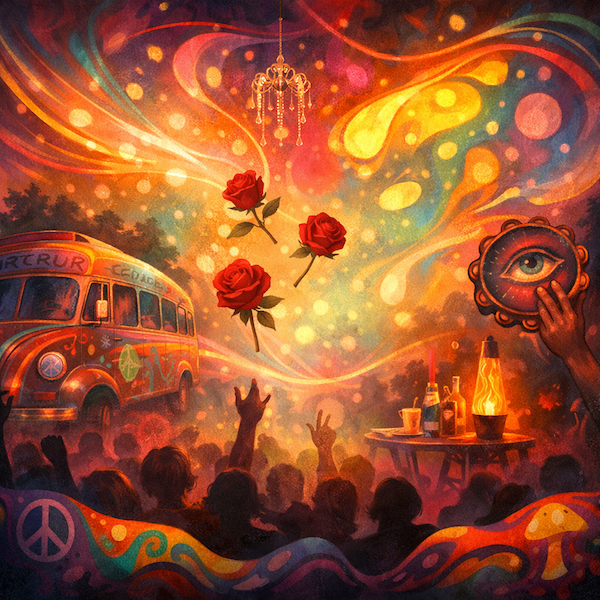
I was lucky enough to step into that world myself, even if I didn’t fully understand it at the time. In 1985, my dad took me to see the Grateful Dead at Alpine Valley Music Theatre outside of Milwaukee. I was maybe eight years old—old enough to notice what was happening, young enough to have absolutely no context for it. At one point during the show, a woman walked up to me, smiled, and handed me a rose. She also happened to be wearing no clothes. I turned to my dad and said, “Dad… she’s wearing no clothes.” He looked at me and said, “Yup. That happens.” No panic. No lecture. Just an understanding that this openness, this weirdness, this unapologetic humanity, was part of the Grateful Dead universe.
That moment stuck with me because it perfectly captures what Bob Weir and the Grateful Dead helped create. A space where people showed up as they were. Where the rules were loose. Where music mattered more than fitting in. The Dead weren’t just a band you listened to—they were something you entered. And Bob Weir helped hold that space together for decades.
Now, with Bob Weir gone and Jerry Garcia having died in 1995, it’s impossible not to take inventory. Ron “Pigpen” McKernan died back in 1973. The band as it once existed has been gone for years. Only a few pillars remain: Phil Lesh, Mickey Hart, and Bill Kreutzmann. And somehow, knowing that makes this moment feel even heavier. The Grateful Dead were never meant to be frozen in time, but watching the circle narrow forces the realization that an era isn’t just fading—it’s closing. The music continues. The community continues. But the people who built it from nothing, who invented it by doing instead of planning, are becoming history themselves.
After Garcia’s death, Weir didn’t retreat into nostalgia or turn the music into a museum piece. He kept moving forward—forming RatDog, collaborating widely, and continuing to reinterpret the catalog with the same curiosity that defined the Acid Test days. He understood something crucial: the music only stays alive if it keeps changing.
Bob Weir’s passing marks the loss of more than a guitarist or a singer. It marks the loss of a steward of an idea—that music could be communal, imperfect, risky, and deeply human. Episode 1332 of Rolling with Scissors honors Bob Weir by spending time inside the music and the movement he helped sustain, from a 16-year-old kid meeting Jerry Garcia to the chaos of the Acid Tests, the songwriting clarity of American Beauty, the shared joy of Europe ’72, and the living memory of those still here to carry it forward.
It really was a long strange trip. And now, for the first time, you can see the end of the road in the distance.
Hour 1
Artist – Song – Time – Album – Label
Grateful Dead – Box Of Rain – 05:18 – American Beauty – Rhino – 1970
Grateful Dead – Friend Of The Devil – 03:24 – American Beauty – Rhino – 1970
Grateful Dead – Sugar Magnolia – 03:19 – American Beauty – Rhino – 1970
Grateful Dead – Operator – 02:25 – American Beauty – Rhino – 1970
Grateful Dead – Candy Man – 06:14 – American Beauty – Rhino – 1970
Grateful Dead – Ripple – 04:09 – American Beauty – Rhino – 1970
Grateful Dead – Brokedown Palace – 04:09 – American Beauty – Rhino – 1970
Grateful Dead – Till The Morning Comes – 03:08 – American Beauty – Rhino – 1970
Grateful Dead – Attics Of My Life – 05:12 – American Beauty – Rhino – 1970
Grateful Dead – Truckin’ – 05:03 – American Beauty – Rhino – 1970
Hour 2
Artist – Song – Time – Album – Label
Grateful Dead – Uncle John’s Band – 04:45 – Workingman’s Dead – Warner Bros. – 1970
Grateful Dead – High Time – 05:15 – Workingman’s Dead – Warner Bros. – 1970
Grateful Dead – Dire Wolf – 03:15 – Workingman’s Dead – Warner Bros. – 1970
Grateful Dead – New Speedway Boogie – 04:07 – Workingman’s Dead – Warner Bros. – 1970
Grateful Dead – Cumberland Blues – 03:18 – Workingman’s Dead – Warner Bros. – 1970
Grateful Dead – Black Peter – 05:44 – Workingman’s Dead – Warner Bros. – 1970
Grateful Dead – Easy Wind – 05:00 – Workingman’s Dead – Warner Bros. – 1970
Grateful Dead – Casey Jones – 04:24 – Workingman’s Dead – Warner Bros. – 1970
Grateful Dead – Cumberland Blues – 05:43 – Europe ’72 Disc 1 – Warner Bros. Records – 1972
Grateful Dead – He’s Gone – 06:57 – Europe ’72 Disc 1 – Warner Bros. Records – 1972
Grateful Dead – One More Saturday Night – 04:49 – Europe ’72 Disc 1 – Warner Bros. Records – 1972
Hour 3
Artist – Song – Time – Album – Label
Grateful Dead – Jack Straw – 04:49 – Europe ’72 Disc 1 – Warner Bros. Records – 1972
Grateful Dead – You Win Again – 04:00 – Europe ’72 Disc 1 – Warner Bros. Records – 1972
Grateful Dead – China Cat Sunflower – 05:33 – Europe ’72 Disc 1 – Warner Bros. Records – 1972
Grateful Dead – I Know You Rider – 05:03 – Europe ’72 Disc 1 – Warner Bros. Records – 1972
Grateful Dead – Brown-Eyed Woman – 04:38 – Europe ’72 Disc 1 – Warner Bros. Records – 1972
Grateful Dead – Hurts Me Too – 07:20 – Europe ’72 Disc 1 – Warner Bros. Records – 1972
Grateful Dead – Ramble On Rose – 06:04 – Europe ’72 Disc 1 – Warner Bros. Records – 1972
Grateful Dead – Sugar Magnolia – 07:10 – Europe ’72 Disc 1 – Warner Bros. Records – 1972
Grateful Dead – Mr. Charlie – 03:39 – Europe ’72 Disc 1 – Warner Bros. Records – 1972
Grateful Dead – Tennessee Jed – 07:18 – Europe ’72 Disc 1 – Warner Bros. Records – 1972
Grateful Dead – The Stranger (Two Souls in Communion) – 06:50 – Europe ’72 Disc 1 – Warner Bros. Records – 1972
Grateful Dead – Truckin’ – 13:06 – Europe ’72 Disc 2 – Warner Bros. Records – 1972
Grateful Dead – Prelude – 07:37 – Europe ’72 Disc 2 – Warner Bros. Records – 1972
Grateful Dead – Epilogue – 05:10 – Europe ’72 Disc 2 – Warner Bros. Records – 1972
Grateful Dead – Morning Dew – 11:41 – Europe ’72 Disc 2 – Warner Bros. Records – 1972
Grateful Dead – Looks Like Rain – 07:42 – Europe ’72 Disc 2 – Warner Bros. Records – 1972
Grateful Dead – Good Lovin’ – 18:30 – Europe ’72 Disc 2 – Warner Bros. Records – 1972 [fade out]
Rolling with Scissors airs live every Tuesday from 2–5 AM on 89.9 FM in Madison and streams at wortfm.org. Missed it? You can catch the episode for two weeks after broadcast at archive.wortfm.org or at rwsradio.com.
While the audio disappears after two weeks, the episode notes and playlists don’t. Every deep dive, rant, and full album breakdown stays right here — so you can revisit the details any time.
Spin the dial — we’re probably on it. Lock onto your frequency. Pick your favorite antenna below and ride the signal back to us.
Facebook | Instagram | Threads | Bluesky | X (Twitter)
0 Comments