Before I ever learned how to slice tape with a razor blade, radio for me was about something much simpler: grabbing a CD, throwing it in the player, and opening the mic manually. It was live, raw, and powered by human hands. And because human fingers aren’t perfect, mistakes happened — a late fade, a fumbled button, a CD that skipped at the worst possible moment. But that was part of the beauty of it. Live radio is human. It breathes, it falters, it surprises. That energy is what pulled me in and kept me coming back.
When editing came along — first with tape and later with software — it didn’t replace that live magic, but it gave us new tools. Suddenly we could polish things, fix mistakes, and make shows sound bigger than our fingers alone could manage. That’s where the story of modern radio production really begins.
The Old Way: Tape, Razor Blades, and Patience
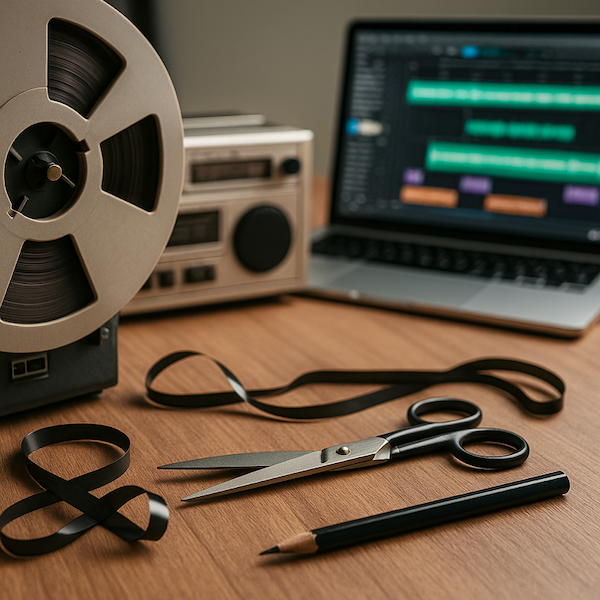
Before the computer took over, editing audio meant physically cutting and splicing tape. I’ve done my share of it, hunched over a block with a razor blade, praying I didn’t miss a breath or chop half a word. It was precise work, and it gave you a kind of respect for the craft. If you wanted a “seamless” edit, you had to earn it.
When software entered the picture, it felt like a revelation. Suddenly, edits weren’t permanent until you hit save. Suddenly, you could experiment without wasting tape. The learning curve was steep, but once you got it, there was no going back.
My DAW Journey
Over the years, I’ve lived in a lot of different DAWs (Digital Audio Workstations).
- Sound Forge always had a special place in my heart for its simplicity and precision.
- Vegas and Acid (both from Sony) gave me room to experiment with layering and sequencing in ways that tape never could.
- For the last several years, I’ve been working in Studio One, which has been rock solid for radio and music production alike.
I’m still making records, though my output isn’t constant. I actually released one earlier in 2025, but I’m not sure if another will come in 2026 — it depends on where life takes me. The truth is, I can’t force it. Historically, my most creative periods come when my world is falling apart. It’s not the healthiest process, but it’s honest, and it’s the way I’ve always made music.
That’s why the subscription model feels like a bad fit for me. Studio One now runs $15 a month, which adds up quickly for a tool I use heavily at times but sporadically at others. It doesn’t make sense to pay on autopilot for something that only comes alive when the inspiration (or chaos) hits.
Enter Reaper
I’ve been evaluating Reaper for the last couple of days, and once I wrapped my head around how it works, the decision became clear. It costs $60 for a lifetime license. That’s it. No monthly bill, no “essential features locked behind a tier,” no bait-and-switch upgrades. Just a fully functional DAW that does everything I need to make a professional radio program.
And honestly? It feels liberating. My entire workflow is digital now — assembling sets, balancing audio, inserting my mic breaks between songs — and with Reaper, it’s streamlined, flexible, and affordable.
Why It Matters
Radio shows used to be pieced together by hand. Today, I can build three hours of chaos, segues, and deep dives entirely on a laptop, export it, and ship it to the station with a few clicks. That transformation — from CD players and live mic fumbles, to razor blades and tape, to Reaper sessions — is the story of modern radio production.
For me, Rolling with Scissors has always been about celebrating the music I love, but behind the scenes, it’s also about adapting. Whether it’s moving studios, shifting workflows, or changing DAWs, the goal is the same: keep the music alive and get it out to the people who want to hear it.
Have something to say? We welcome your comments below — this is where the real conversation happens.
Each blog post is shared across our social transmitters, but those are just bigger antennas. The original source — and the signal we control — is right here on the blog. If you’re looking for other ways to stay updated on Rolling with Scissors, you’ll find our official transmitters linked below.
Spin the dial — we’re probably on it. Lock onto your frequency. Pick your favorite antenna below and ride the signal back to us.
Facebook • Instagram • Threads • Bluesky • X (Twitter)
0 Comments