I’ve been trying to make sense of what’s been happening in Minneapolis over the last few weeks, and the more I read, the less comfortable I feel. Not just about the individual incidents themselves, but about the direction they seem to point toward if nobody slows things down long enough to ask hard questions.
Two people dead in encounters involving federal immigration agents. Conflicting narratives. Video evidence that doesn’t neatly line up with official statements. Masked officers. Jurisdictional confusion. A lot of “trust us” being asked of a public that has already learned—more than once—that trust without accountability tends to age badly.
This isn’t about reacting emotionally. It’s about pattern recognition.
This Isn’t Really About Immigration
Immigration is the justification being used right now. It’s the label attached to these operations. But labels have always been the easiest part of expanding authority.
What concerns me is how quickly a category gets defined, enforced, and then quietly broadened. Today it’s immigration. Tomorrow it’s something else. History—both recent and distant—shows that once a system becomes comfortable operating with reduced transparency and expanded force, it rarely confines itself to its original mission.
That’s not paranoia. That’s how institutional power behaves.
I know the instinctive response to this line of thinking is “that’s a stretch.” And maybe at first, it is. But stretches have a way of becoming normal when each step is small enough to defend on its own.
Why This Feels Personal to Me
I’m disabled. I live in a body that already gets assessed, categorized, documented, and evaluated more than most. I’ve spent my life navigating systems that decide who qualifies, who doesn’t, who is “functional enough,” who requires oversight, and who is quietly treated as a problem to be managed.
So when I see armed federal agents operating under vague authority, with shifting narratives and limited transparency, my brain doesn’t jump to comfort. It jumps to patterns.
If a system can decide one group is the problem, what keeps it from deciding another group is next?
That’s not a slippery slope argument. That’s a historical one.
We’ve Been Here Before—More Than Once
I had similar concerns during the post–9/11 years. I remember the atmosphere clearly. Questioning the official narrative was framed as disloyal, dangerous, even traitorous. Ask the wrong question and you were told you hated America. The language of “domestic threats” and “extremism” expanded quickly, and fear did most of the heavy lifting.
Some of the worst predictions from that era didn’t come true. That matters. But it doesn’t erase the reality that power expanded rapidly, surveillance normalized, and accountability lagged far behind authority.
Historically, this isn’t unique to the United States. Governments don’t usually leap directly into authoritarianism. They move incrementally. Each step is justified by urgency. Each exception is framed as temporary. Each workaround becomes precedent.
When the Guardrails Themselves Get Questioned
There’s another layer to all of this that I’ve been wrestling with, and I want to be careful here—not because the concern isn’t real, but because accuracy matters more than outrage.
Over the past few weeks, there have been widely reported comments attributed to the current administration suggesting—at least rhetorically—that elections are something to complain about, mock, or casually question. In one instance, the president was quoted saying something along the lines of “we shouldn’t even have an election” while discussing upcoming midterms. Officials later framed the remark as facetious or taken out of context, and to be clear, there has been no formal proposal, no executive action, and no legal mechanism to cancel or suspend federal elections.
But rhetoric matters, even when it isn’t policy.
Democratic systems don’t usually fail because someone announces the end out loud. They erode when the idea that elections are optional, inconvenient, or negotiable gets floated casually enough that people stop reacting to it. When the guardrails themselves become subjects of debate instead of assumptions, something has already shifted.
This isn’t about personalities. It’s about precedent.
Why This Caught My Attention—Even After I Walked Away
What makes this harder to ignore is that I’m not plugged into the daily media cycle anymore.
I’ve talked before about stepping back from social media and constant news consumption, and for the most part, that’s still true. I don’t doom-scroll. I don’t live on Twitter. I made a conscious decision to pull away because I didn’t like what constant exposure was doing to my head.
So when something breaks through that filter—when I notice it despite my limited media intake—that tells me something else is going on.
If even I’m seeing these stories bubble up, then the volume has reached a point where it can’t be dismissed as algorithmic amplification or partisan noise. This isn’t just one headline or one bad edit. It’s a convergence of events, language, and actions that are leaking into the broader public consciousness whether people want them to or not.
That’s why I’m talking about this now.
The Dangerous Temptation of Escalation
I’ll be honest—my thinking on this shifted as I sat with it.
At first, I found myself wondering why people weren’t physically pushing back. When masked, heavily armed individuals claim federal authority, it’s reasonable to ask who they are and under what oversight they’re operating. Rapid expansion, financial incentives, and vague chains of command raise real questions.
But then the next thought landed.
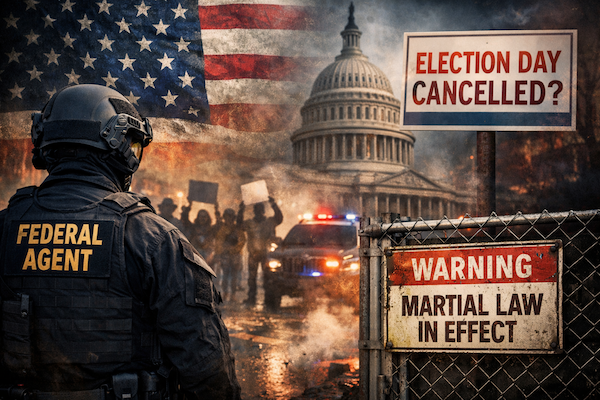
If people began physically attacking federal officers—even out of justified anger—that would instantly become justification for something far worse. That’s when the language shifts from “enforcement” to “insurrection.” That’s when rarely used laws suddenly come back into play. From there, the distance to martial law stops being theoretical.
And martial law is not a reset button.
To the best of my knowledge, it has never been fully enacted nationwide in modern U.S. history. There have been moments that came close—curfews, citywide lockdowns, movement restrictions. After the Boston Marathon bombing, much of the city shut down. People accepted it because it felt targeted and temporary.
History shows that once extraordinary measures are normalized in response to unrest rather than disaster, they’re far harder to unwind.
Proximity Matters More Than We Like to Admit
I live in a small college town in northern Wisconsin. We like to think we’re insulated from what happens in Minneapolis. But Minneapolis is about an hour and a half away.
We have immigrants here. We have minorities here. We have disabled people here. We have people who already live closer to the margins than they should.
If authority can be stretched in a major city, it can be driven down the highway.
That’s not fearmongering. That’s geography.
The Question We Can’t Afford to Avoid
I’m not saying we’re already there. I am saying we’re closer to the edge than we’re willing to admit.
The real danger isn’t a dramatic overnight collapse. It’s normalization. It’s when each step feels just small enough to tolerate. When people who raise concerns are dismissed as overreacting. When accountability becomes optional as long as the right language is used.
I don’t have neat answers. I’m not pretending to. What I do know is that silence has never made power more responsible, and ignoring patterns has never stopped them from repeating.
Maybe this is the moment to talk about it—not in panic, not in slogans, not in absolutes—but honestly, carefully, and before the next step feels inevitable instead of preventable.
Because once a line gets crossed quietly, arguing about where it used to be doesn’t do much good.
Have something to say? We welcome your comments below — this is where the real conversation happens.
Each blog post is shared across our social transmitters, but those are just bigger antennas. The original source — and the signal we control — is right here on the blog. If you’re looking for other ways to stay updated on Rolling with Scissors, you’ll find our official transmitters linked below.
Spin the dial — we’re probably on it. Lock onto your frequency. Pick your favorite antenna below and ride the signal back to us.
Facebook • Instagram • Threads • Bluesky • X (Twitter)
0 Comments