
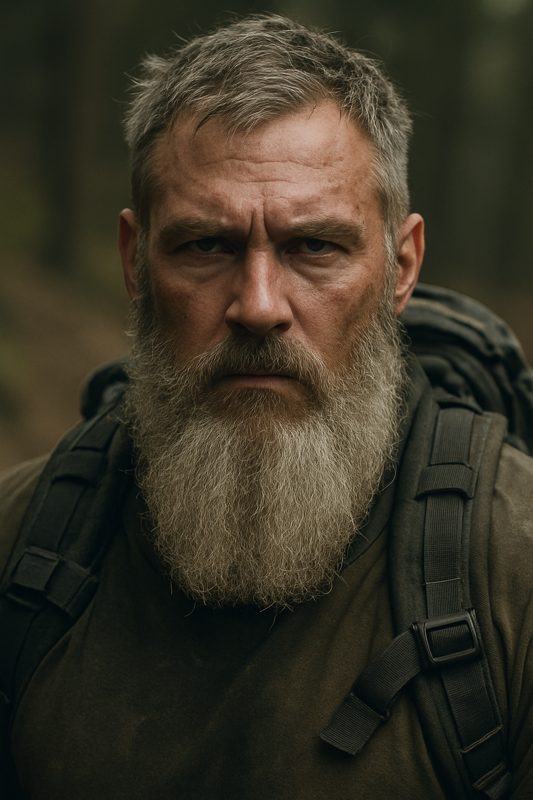
Cronauer
Cronauer grew up in Madison, Wisconsin, obsessed with radio from a young age. He got his start volunteering at WORT Community Radio as a teenager, where he learned to solder, broadcast, and hold space for voices that didn’t usually get heard. After the death of his sister Rebecca, and growing distance from his surviving family, Cronauer enlisted in the Marines with two of his closest friends, Rick and Josh. The three of them left behind tech jobs and complicated relationships, seeking structure in chaos. While stationed overseas, Cronauer specialized in field communications and emergency broadcast operations—skills that now define his post-collapse survival.
After leaving the service, he built a quiet career in IT, bouncing between freelance gigs and mid-level consulting contracts. Beneath the routine, though, he felt a growing itch—an unease with what the world was becoming. When everything finally unraveled, Cronauer didn’t break. He adapted. Rebuilt. Started over. Not to restore the old world, but to amplify the voices trying to make sense of the new one.
Personality:
• Principled but jaded. Deeply committed to free expression and personal autonomy, but skeptical of institutions and hero narratives.
• Introverted with selective vulnerability. Doesn’t open up easily, but when he does, it’s real and raw.
• Mentally tough, emotionally scarred. Still processing grief, survivor’s guilt, and broken relationships that never had closure.
• Highly skilled under pressure. Falls apart in silence, thrives in chaos.
Disability Note:
In real life, Cronauer uses a wheelchair. In the world of Signal Drift, the chair is absent—not because it’s ignored, but because this is the internal world where he moves as freely as he imagines. It’s not about erasing the reality—it’s about reclaiming the dream.
Gear:
Glock 19, .308 rifle, custom ham radio rig, analog toolkit, military-grade headphones, scavenged solar rig
Motivations:
• To preserve human connection in a world that’s crumbling into static and fear.
• To rebuild the signal—not just the literal radio waves, but the metaphor for resistance, hope, and shared truth.
• To reconcile the past—especially the people he lost, or pushed away, before the collapse.
Emotional Baggage:
Cronauer has not spoken to his sister Sarah in years. He has no idea if she’s alive.
But deeper still is the memory of a woman he loved—someone he left behind when he enlisted. They never properly ended things. Their relationship got tangled in fear, ambition, and unspoken regrets. He told himself it wouldn’t have worked, that she was better off. But he still thinks about her. In quiet moments. In the spaces between transmissions.
Coming arc: She survived. She’s out there. And somehow, through a fragment of signal, or a rumor passed down through the barter chain, she’s going to find out he’s still alive.
And she’s going to come looking.

Norm Stockwell (“Ghost of Tom Joad”)
Based on: Real person, former WORT operations coordinator. Role: Mentor, voice of community radio, survivor holding the line in Madison. Backstory: Stayed behind at WORT after the collapse. Keeps the station alive with grit, solder, and soul. Personality: Grounded, gruff, deeply committed to people and principles. Gear: Ham gear, analog maps, old-school tools, .308 rifle. Motivation: To preserve a voice for the voiceless. A stubborn believer in decentralized resistance.
David Devereaux-Weber (Dave)
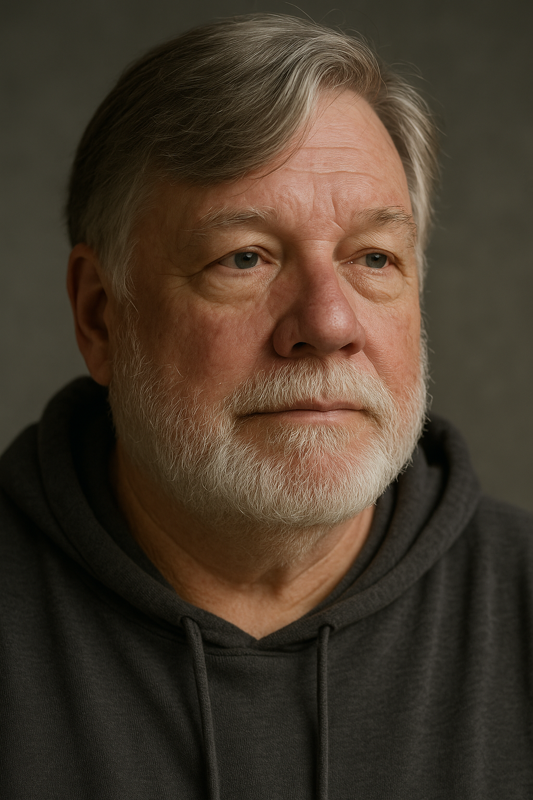
Based on: Real person, longtime radio contributor and educator. Role: Old friend, Viroqua’s de facto engineer and caretaker. Backstory: Retired to Viroqua pre-collapse. Tried to keep their LPFM station running when everything fell apart. Personality: Calm, dry-witted, practical. Keeps things from tipping into chaos. Gear: VW microbus, partial station setup, steady hands. Motivation: To keep a small town connected. To help Cronauer revive the signal.

Bill Norman
Based on: A real person and lifelong friend of the author. Bill has been in Lucas’s life since they were around twelve years old.
Role: Unpredictable ally, hands-on problem solver, chaotic genius, and eventual core member of the team. Bill’s the wild card you never see coming—but somehow, he always pulls it off.
Backstory: Bill was always the kid with the insane idea—and the nerve to actually do it. Whether it was getting zipped into a hockey bag and dropped on someone’s porch, trying to light a bucket of pee on fire, or returning a Sunny D bottle filled with urine to the store shelf, he never saw limits the way others did. In high school, he and Lucas tore through gravel pits in a jacked-up 4×4 doing donuts until the tires smoked. That truck? He still has it. After years running A/V for live bands and cruise ships, Bill disappeared off-grid, landing back in rural Wisconsin—just in time for the world to end.
Appearance: Mid-to-late 40s. White male. Long, wild hair and a scruffy beard. Often found wearing snow pants and a puff jacket no matter the season. His eyes are sharp, always scanning for problems—and unconventional ways to solve them. He looks like someone who could rewire your house or blow it up, depending on his mood.
Personality: Equal parts genius and chaos. Think MacGyver if he was raised on Nine Inch Nails and burned-out stage gear. Bill doesn’t think outside the box—he forgets the box exists. He’ll either drive you insane or save your life with a contraption made from rope, oil, and a car battery. He’s intense, deeply loyal, and always three steps ahead in ways that don’t make sense until they do.
Skills and Strengths: Master of improvisation. Audio and electrical systems. Off-grid survival. Vehicular modifications. Junkyard innovation. Pyrotechnics. If it needs to be fixed, exploded, or repurposed, Bill has an idea. Probably a dangerous one—but it’ll work.
Gear: The Beetle Bomb—a sunset-orange, heavily modified 4×4 he’s had since high school, now converted to run on biodiesel. It’s loud, reckless, and nearly indestructible—just like Bill. His toolkit includes a rotating stash of hand tools, explosives, rigging gear, random fuel containers, and, of course, a paper bag filled with dog shit—a trademark move that somehow always finds a purpose.
Motivation: Bill doesn’t give a damn about authority or order. He cares about people—his people—and making sure they survive. He’s not trying to build a new world. He’s here to make sure the old one doesn’t bury the wrong ones with it.
Eli (“Simple Farmer”)
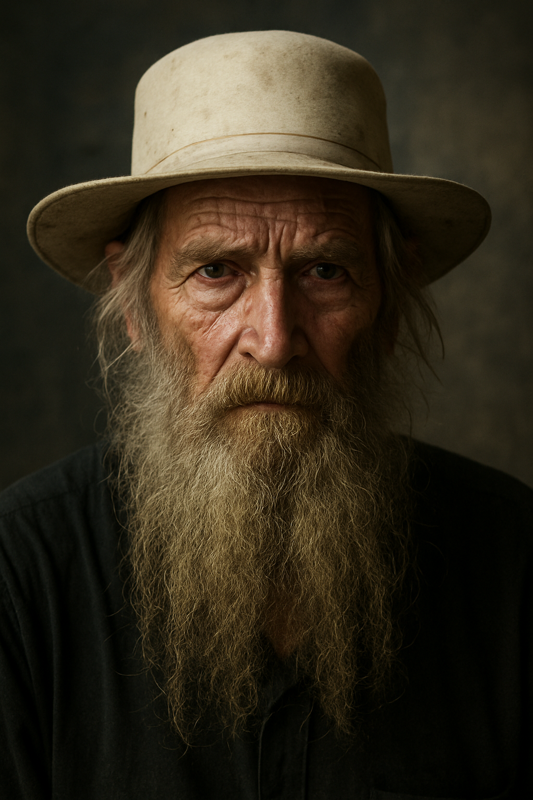
Based on: Inspired by rural survivalists and the quiet resilience of Amish/Mennonite culture. Composite of real-world farmers and off-grid thinkers. Role: Quiet early ally. The first stable contact Cronauer makes on his journey west. Provides transportation, spiritual contrast, and emotional grounding. Age: Late 60s to early 70s. Appearance: White male, long graying beard, deeply lined face from years of hard labor. Wears plain clothes — typically suspenders, work shirt, and a wide-brimmed white hat. Hands are scarred and strong. His eyes are soft, but alert. Voice/Vibe: Speaks slowly, with purpose. Soft-spoken but firm. Rarely wastes words. Projects wisdom without ever claiming it.
Backstory: Eli was raised in a conservative Amish settlement outside Soldiers Grove, Wisconsin. As a younger man, he followed the Ordnung faithfully — no electricity, no modern machines, no formal education past eighth grade. But he was always curious. Quietly, he began experimenting with technology on the fringes. Not in defiance of faith, but in pursuit of usefulness. When the collapse began, his world split in two: the community he was part of dissolved, either retreating deeper into isolation or falling apart under pressure. Eli stayed behind—not because he rejected them, but because he believed survival would require both tradition and adaptation. He salvaged what he could: parts, tools, books. He taught himself basic electronics. Built his own ham radio rig from scavenged components. He still lives without internet, television, or anything resembling luxury—but he has a generator, a signal, and a horse-drawn buggy that’s been reinforced with modern tires and LED running lights.
Philosophy/Beliefs: Eli is deeply spiritual but not dogmatic. He believes in a creator, in stewardship of the land, and in the value of silence. But he also believes that clinging to rules while the world burns is a kind of pride. To him, God gave man the ability to think, build, and adapt. He sees tools—radios, solar panels, even antibiotics—not as sins, but as extensions of human care and responsibility. His morality is measured in compassion, not compliance.
Skills and Strengths: Self-sufficiency (can grow, fix, or jury-rig almost anything); ham radio (self-taught, built his own transceiver); horsemanship; mechanics and tools; medical basics; situational awareness; trust builder (one of the few characters who gains Cronauer’s trust instantly—and deserves it).
Weaknesses: Isolation; trauma (grief from losing his community, which he rarely speaks about); nonviolent instinct (will defend himself, but only as a last resort); emotionally closed-off (compassionate but private).

Emmy Pickett (Audrey)
Role in Story: Cronauer’s long-lost best friend, unspoken love, and emotional anchor
Profession (Pre-collapse): Veterinarian
Current Status: Surviving alone or with a small crew, possibly traveling with rescued animals or maintaining a mobile field clinic
Personality:
• Deeply compassionate, grounded, and naturally warm
• Incredibly intuitive — often knew what Cronauer was feeling even when he didn’t say it
• Has a quiet strength, able to survive without becoming hard
• Witty, thoughtful, and fiercely loyal
• The kind of person who remembers birthdays, mixtape lyrics, and what your laugh sounds like in the dark
Shared History with Cronauer:
• Met in high school theater productions — she was the one who could sing, always cast in the lead
• Cronauer ran sound, lights, and tech. They shared hours backstage, and hours more just being together afterward
• He made her mixtapes — dozens of them — filled with carefully chosen tracks that said everything he was too scared to
• “You’ve Got a Friend” by James Taylor was always on those tapes. It became his message to her
• He never told her he loved her. She probably knew anyway
• When she got married and moved away, they lost touch — but not because they wanted to
Signal Drift Tie-in:
• Cronauer’s voice goes out over the repeater in Chapter 10 or 11
• She hears it. The cadence. A phrase. Maybe even something lifted from “You’ve Got a Friend”:
• “Close your eyes and think of me…”
• “Call out my name, and soon I’ll be there…”
• Cronauer could close a test transmission with something subtle:
• “Wherever you are, if you still remember… just call my name.”
• Emmy picks up on it instantly
• Her reply is broken, patchy — but it carries her voice. The story turns
Current Life (Post-collapse):
• She’s been running a makeshift animal triage shelter out of an old veterinary van or rural clinic
• Has likely been moving often to stay safe or help others
• She’s experienced real loss — maybe her partner or crew didn’t survive
• She never forgot Cronauer. Maybe even still has one of those tapes
Narrative Use:
• Emotional mirror to Cronauer: everything unsaid, unresolved
• Gives us a break from the technical and logistical — a character-driven, heart-heavy chapter to balance the tone
• Possible future companion or foil. She doesn’t have to stay forever. She can challenge him, question the mission, or even lead a breakaway broadcast
Gear: Horse and buggy reinforced with modern upgrades; ham radio rig wired into salvaged deep-cycle batteries; home-built water catchment and filtering system; field tools, canned food, paper maps, and a hidden long-barreled shotgun (kept covered, never carried).
Motivation: To survive with integrity. To preserve something human and humble in a world unraveling at the seams. He doesn’t seek power, control, or status. He just wants to be useful—and to know that somewhere out there, other people still remember how to listen.
ulness. When the collapse began, his world split in two: the community he was part of dissolved, either retreating deeper into isolation or falling apart under pressure. Eli stayed behind—not because he rejected them, but because he believed survival would require both tradition and adaptation. He salvaged what he could: parts, tools, books. He taught himself basic electronics. Built his own ham radio rig from scavenged components. He still lives without internet, television, or anything resembling luxury—but he has a generator, a signal, and a horse-drawn buggy that’s been reinforced with modern tires and LED running lights.
Philosophy/Beliefs: Eli is deeply spiritual but not dogmatic. He believes in a creator, in stewardship of the land, and in the value of silence. But he also believes that clinging to rules while the world burns is a kind of pride. To him, God gave man the ability to think, build, and adapt. He sees tools—radios, solar panels, even antibiotics—not as sins, but as extensions of human care and responsibility. His morality is measured in compassion, not compliance.
Skills and Strengths: Self-sufficiency (can grow, fix, or jury-rig almost anything); ham radio (self-taught, built his own transceiver); horsemanship; mechanics and tools; medical basics; situational awareness; trust builder (one of the few characters who gains Cronauer’s trust instantly—and deserves it).
Weaknesses: Isolation; trauma (grief from losing his community, which he rarely speaks about); nonviolent instinct (will defend himself, but only as a last resort); emotionally closed-off (compassionate but private).

Jamie “The Reverend” Lowden
• Nickname: The Reverend — earned from his barefoot, long-haired, almost spiritual presence and the way he talked about music and code like gospel.
• Appearance: 6’2”, long hair down to his waist, always barefoot (even in winter), rail-thin, wide-eyed, looks like he’s either on mushrooms or building a Linux distro from scratch (or both).
• Personality: Brilliant, awkward, unpredictable. He’s the kind of guy who writes encryption tools for fun and disappears into the woods for weeks to “reset his frequency.”
• Background:
• Music and code nerd. Knew nothing about radio until Cronauer dragged him into the station.
• Hacked the local public TV station once to loop The Outer Limits for 24 hours straight.
• Smoked the best weed Cronauer ever had.
• Friend of Bill Norman. The three of them go way back — late-night radio, dumpstered pizza, weird broadcast experiments.
• Current Whereabouts: Rumored to be at a place called The Bluffs, a fortified survivor outpost west of the Mississippi, run by Elliot “The Engine” Kohler.
• Call Sign (Ham Radio): TBD — we’ll work one in when we get to the radio contact in Chapter 13.
• Role in Story: Will become critical in helping establish a secure broadcast infrastructure once DHS starts clamping down. He knows how to ghost an entire radio setup.
• Met in high school theater productions — she was the one who could sing, always cast in the lead
• Cronauer ran sound, lights, and tech. They shared hours backstage, and hours more just being together afterward
• He made her mixtapes — dozens of them — filled with carefully chosen tracks that said everything he was too scared to
• “You’ve Got a Friend” by James Taylor was always on those tapes. It became his message to her
• He never told her he loved her. She probably knew anyway
• When she got married and moved away, they lost touch — but not because they wanted to
Signal Drift Tie-in:
• Cronauer’s voice goes out over the repeater in Chapter 10 or 11
• She hears it. The cadence. A phrase. Maybe even something lifted from “You’ve Got a Friend”:
• “Close your eyes and think of me…”
• “Call out my name, and soon I’ll be there…”
• Cronauer could close a test transmission with something subtle:
• “Wherever you are, if you still remember… just call my name.”
• Emmy picks up on it instantly
• Her reply is broken, patchy — but it carries her voice. The story turns
Current Life (Post-collapse):
• She’s been running a makeshift animal triage shelter out of an old veterinary van or rural clinic
• Has likely been moving often to stay safe or help others
• She’s experienced real loss — maybe her partner or crew didn’t survive
• She never forgot Cronauer. Maybe even still has one of those tapes
Narrative Use:
• Emotional mirror to Cronauer: everything unsaid, unresolved
• Gives us a break from the technical and logistical — a character-driven, heart-heavy chapter to balance the tone
• Possible future companion or foil. She doesn’t have to stay forever. She can challenge him, question the mission, or even lead a breakaway broadcast
Gear: Horse and buggy reinforced with modern upgrades; ham radio rig wired into salvaged deep-cycle batteries; home-built water catchment and filtering system; field tools, canned food, paper maps, and a hidden long-barreled shotgun (kept covered, never carried).
Motivation: To survive with integrity. To preserve something human and humble in a world unraveling at the seams. He doesn’t seek power, control, or status. He just wants to be useful—and to know that somewhere out there, other people still remember how to listen.
ulness. When the collapse began, his world split in two: the community he was part of dissolved, either retreating deeper into isolation or falling apart under pressure. Eli stayed behind—not because he rejected them, but because he believed survival would require both tradition and adaptation. He salvaged what he could: parts, tools, books. He taught himself basic electronics. Built his own ham radio rig from scavenged components. He still lives without internet, television, or anything resembling luxury—but he has a generator, a signal, and a horse-drawn buggy that’s been reinforced with modern tires and LED running lights.
Philosophy/Beliefs: Eli is deeply spiritual but not dogmatic. He believes in a creator, in stewardship of the land, and in the value of silence. But he also believes that clinging to rules while the world burns is a kind of pride. To him, God gave man the ability to think, build, and adapt. He sees tools—radios, solar panels, even antibiotics—not as sins, but as extensions of human care and responsibility. His morality is measured in compassion, not compliance.
Skills and Strengths: Self-sufficiency (can grow, fix, or jury-rig almost anything); ham radio (self-taught, built his own transceiver); horsemanship; mechanics and tools; medical basics; situational awareness; trust builder (one of the few characters who gains Cronauer’s trust instantly—and deserves it).
Weaknesses: Isolation; trauma (grief from losing his community, which he rarely speaks about); nonviolent instinct (will defend himself, but only as a last resort); emotionally closed-off (compassionate but private).

Joy Luebke
Grew up in Beloit, Wisconsin. She graduated from Beloit Memorial High School in 1965 and married Ron Luebke not long after. Joy began her career in public service as a librarian, eventually becoming the head librarian at the Evansville Public Library. In 1996, she and Ron moved to Viroqua to pursue a quieter, more self-sustaining life, where they started farming together.
Her involvement in the local farming community quickly expanded. She became a regular fixture at the town’s food co-op, and in the early 2000s, she took over management of the co-op itself. Her deep roots in the agricultural world and her organizational mindset made her a vital part of the Viroqua community.
Property and Resources:
Joy owns 75 acres on Nottingham Ridge, just outside of town. The farm is fully operational with a variety of livestock, including dairy cows. On the property sits a large pole barn that will become critically important in the future storyline. The barn contains:
• A fully equipped woodworking shop with nearly every tool imaginable
• A significant supply of lumber, food, and practical materials
• An old veterinary ambulance, converted to run on biodiesel in the early 2000s. The vehicle is entirely analog — no digital systems — meaning it still functions when others fail
Community Role:
Joy is also a longtime member of the Order of Knitting Women, a group of women in Viroqua known for making sweaters, socks, and other crafts — mostly for holidays and fundraisers in the past. In the aftermath of the collapse, this group takes on a much more important role, helping to supply clothing and essentials to the community as infrastructure fails.
Personality and Traits:
Joy is level-headed, deeply resourceful, and known for her quiet but commanding presence. She doesn’t speak unless she has something to say, but when she does, people listen. She’s the kind of person who plans ahead without drawing attention to herself — and as the world falls apart, that mindset turns out to be invaluable.
She’s a firm believer in people taking care of each other. She’s not flashy, but she’s got a steel backbone. If something needs doing, she’ll find a way to get it done — whether that means fixing a broken fence or organizing an emergency town food distribution. Her resilience and practicality make her one of the core pillars of the new local order forming in Viroqua.
cure broadcast infrastructure once DHS starts clamping down. He knows how to ghost an entire radio setup.
• Met in high school theater productions — she was the one who could sing, always cast in the lead
• Cronauer ran sound, lights, and tech. They shared hours backstage, and hours more just being together afterward
• He made her mixtapes — dozens of them — filled with carefully chosen tracks that said everything he was too scared to
• “You’ve Got a Friend” by James Taylor was always on those tapes. It became his message to her
• He never told her he loved her. She probably knew anyway
• When she got married and moved away, they lost touch — but not because they wanted to
Signal Drift Tie-in:
• Cronauer’s voice goes out over the repeater in Chapter 10 or 11
• She hears it. The cadence. A phrase. Maybe even something lifted from “You’ve Got a Friend”:
• “Close your eyes and think of me…”
• “Call out my name, and soon I’ll be there…”
• Cronauer could close a test transmission with something subtle:
• “Wherever you are, if you still remember… just call my name.”
• Emmy picks up on it instantly
• Her reply is broken, patchy — but it carries her voice. The story turns
Current Life (Post-collapse):
• She’s been running a makeshift animal triage shelter out of an old veterinary van or rural clinic
• Has likely been moving often to stay safe or help others
• She’s experienced real loss — maybe her partner or crew didn’t survive
• She never forgot Cronauer. Maybe even still has one of those tapes
Narrative Use:
• Emotional mirror to Cronauer: everything unsaid, unresolved
• Gives us a break from the technical and logistical — a character-driven, heart-heavy chapter to balance the tone
• Possible future companion or foil. She doesn’t have to stay forever. She can challenge him, question the mission, or even lead a breakaway broadcast
Gear: Horse and buggy reinforced with modern upgrades; ham radio rig wired into salvaged deep-cycle batteries; home-built water catchment and filtering system; field tools, canned food, paper maps, and a hidden long-barreled shotgun (kept covered, never carried).
Motivation: To survive with integrity. To preserve something human and humble in a world unraveling at the seams. He doesn’t seek power, control, or status. He just wants to be useful—and to know that somewhere out there, other people still remember how to listen.
ulness. When the collapse began, his world split in two: the community he was part of dissolved, either retreating deeper into isolation or falling apart under pressure. Eli stayed behind—not because he rejected them, but because he believed survival would require both tradition and adaptation. He salvaged what he could: parts, tools, books. He taught himself basic electronics. Built his own ham radio rig from scavenged components. He still lives without internet, television, or anything resembling luxury—but he has a generator, a signal, and a horse-drawn buggy that’s been reinforced with modern tires and LED running lights.
Philosophy/Beliefs: Eli is deeply spiritual but not dogmatic. He believes in a creator, in stewardship of the land, and in the value of silence. But he also believes that clinging to rules while the world burns is a kind of pride. To him, God gave man the ability to think, build, and adapt. He sees tools—radios, solar panels, even antibiotics—not as sins, but as extensions of human care and responsibility. His morality is measured in compassion, not compliance.
Skills and Strengths: Self-sufficiency (can grow, fix, or jury-rig almost anything); ham radio (self-taught, built his own transceiver); horsemanship; mechanics and tools; medical basics; situational awareness; trust builder (one of the few characters who gains Cronauer’s trust instantly—and deserves it).
Weaknesses: Isolation; trauma (grief from losing his community, which he rarely speaks about); nonviolent instinct (will defend himself, but only as a last resort); emotionally closed-off (compassionate but private).