The climb up Nottingham Ridge wasn’t a hike—it was a mechanical assault. Bill had the “Beetle Bomb” in low gear, the sunset-orange paint job of the modified 4×4 caked in fresh Driftless mud as the oversized tires clawed at the incline. Every time the suspension bottomed out, Cronauer felt it in his spine, a rhythmic jarring that matched the thrum of the diesel engine.
When they finally cleared the treeline and the 125-acre expanse of the Luebke homestead opened up, Bill killed the engine. The silence that followed was absolute, broken only by the “tick-tick-tick” of the cooling manifold and the distant, rhythmic thud of a wood axe.
Standing near a meticulously tilled garden plot was a silhouette Cronauer thought he’d left miles back in the rearview mirror. Eli. The “Simple Farmer” stood there, trowel in hand, looking like he’d grown out of the ridge soil itself.
Cronauer shoved his door open, his boots hitting the gravel before the dust had even settled. “Eli? What the hell are you doing here?”
Bill and Dave scrambled out of the truck, their hands instinctively hovering near their belts. To them, a stranger on a ridge was a threat until proven otherwise. Bill looked at the old man in the wide-brimmed hat like he was expecting him to pull a customized transceiver—or a sidearm—out of the dirt.
“You know this guy?” Bill asked, his voice dropping into that wary, defensive growl.
“Know him?” Cronauer breathed, shaking his head in disbelief. “Eli’s the reason I made it past the first week of the collapse. He’s the first stable ground I found.”
Eli didn’t move, but the corner of his mouth twitched in a ghostly version of a smile. “I told Joy you’d find your way here, Cronauer. You’re a man who follows a frequency. And Joy… well, Joy has the strongest signal on the ridge.”
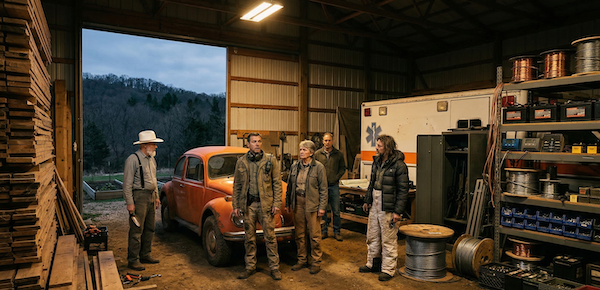
Joy stepped between them, her presence cutting through the reunion like a cold front. She led them toward the massive pole barn—a structure so large it felt like it had its own weather system. When she pulled the heavy sliding doors back, the scent hit them first: a cocktail of seasoned cedar, Hoppe’s No. 9 gun oil, old grease, and the dry, sweet smell of bulk grain.
Inside, it wasn’t just a barn. It was a cathedral of hardware. It was the biggest goddamn hardware store in the state, hidden in plain sight.
Stacks of seasoned oak, pine, and cedar were piled twenty feet high, organized by dimension and grain. There were bins overflowing with galvanized nails, brass screws, and heavy-duty lag bolts that looked like they’d been salvaged from a bridge. Along the west wall stood a line of industrial shelving: rolls of copper wire, heavy-duty deep-cycle batteries still in their boxes, solar charge controllers, and spools of high-tensile steel cable.
“Ron didn’t just buy things,” Joy said, her voice echoing off the corrugated metal ceiling. “He bought the things that make things.”
Deeper in the shadows, the “ambition” Ron had hoarded became clearer. A locked steel cabinet stood open, revealing a hunting legacy repurposed for a new season: scoped .30-06 rifles, 12-gauge pumps, and a pair of rugged AR-15s. Boxes of ammunition were stacked like bricks in a wall—thousands of rounds, organized by caliber.
Beyond the armory was the pantry. Shelves groaned under the weight of #10 cans of flour, sugar, and salt. There were five-gallon buckets of heirloom seeds and a row of chest freezers running on a dedicated solar array.
And then, there was the rig: a boxy, white-and-orange frame of an old ambulance, its “Star of Life” peeling.
“Biodiesel conversion,” Joy noted, nodding toward the rig. “Analog electrical. No computer chips to fry. It’s a tank in a white coat. He spent three years getting it ready.”
Cronauer looked from the copper wire to the ambulance, then back at the stacks of lumber. The technical gears in his head started spinning.
“The station down the road from the library… the LPFM setup… it’s a toy, Joy,” Cronauer said. “Down there, we’re shouting into a pillow. The hills eat the signal before it even clears the city limits. But up here? If we use that lumber and that steel cable to build a proper mast on this ridge—something that clears the treeline by fifty feet—we won’t just reach Viroqua. We’ll hit La Crosse. We might even skip a signal halfway to Madison.”
Bill’s eyes lit up with a chaotic spark. He slapped a hand against a stack of 2x4s. “I can rig the tension wires. We get that ambulance running, we’ve got a mobile repeater. We could ghost the signal all over the county.”
Eli stepped forward, his scarred hands resting on his suspenders.
“Building a tower that high… that’s a lot of eyes on this place,” Eli cautioned. “But I have friends. Men who know how to raise a barn in a day and a steeple in two. If you provide the engineering, Cronauer, we will provide the hands. We’ll build you a tower they can’t ignore.”
Enjoying the story? Signal Drift is unfolding one chapter at a time right here on the blog. Got thoughts, theories, or feedback? Drop a comment below — that’s where the real conversation happens.
Every chapter also beams out through our social transmitters, but if you’ve made it this far, you’re already tuned into the right signal.
Want to dive deeper into the world? Meet the characters of Signal Drift — and keep an eye on that page, because it’ll evolve as the story does.
Spin the dial — we’re probably on it. Lock onto your frequency. Pick your favorite antenna below and ride the signal back to us.
Facebook | Instagram | Threads | Bluesky | X (Twitter)
0 Comments