The ride back from Joy’s ridge was a study in contrasts. In the back of Bill’s truck, Dave and Eli were leaning over a set of hand-drawn schematics, their voices rising and falling over the roar of the wind and the rattle of the tailgate. They were talking about structural loads, guy-wires, and “daisy-chaining” low-power relays. To them, the fifty-foot mast on the ridge was a puzzle to be solved—a way to reclaim the sky.
In the cab, the air was a lot heavier. Bill Norman gripped the steering wheel of the “Beetle Bomb” like he was trying to choke it, his eyes constantly flicking toward the rearview mirror and then up through the windshield, scanning the graying horizon for that matte-black silhouette.
“You worried?” Bill asked, his voice barely cutting through the cab’s rattle. “About that bird spotting us? Or seeing the work on the ridge?”
Cronauer didn’t answer right away. He stared out the side window at the passing oaks, watching the shadows stretch across the Driftless coulees. He thought about the Marine-issue logistics he’d spent a decade memorizing—thermal signatures, flight patterns, and the sheer reach of a DHS sensor array. He thought about the reality of a fifty-foot metal finger pointing straight at the sky.
He let the silence hang for a mile before he finally turned to Bill.
“I don’t fucking know, Bill,” he said, his voice flat and hard. “But fuck ’em. If we stop building because they’re looking, then they’ve already won the frequency.”
Bill didn’t reply, but he pushed the accelerator a little harder, the orange truck kicking up a rooster tail of gravel as they wound their way back toward Viroqua.
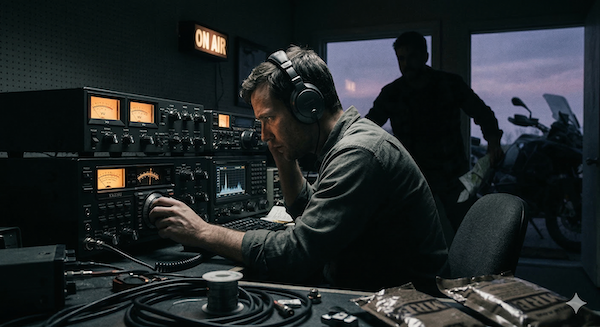
Cronauer let the others head to their respective corners of town to process the day. He needed the studio. He needed the one place where the world felt like it had a dial he could actually turn. He sat in the dim amber glow of the station, the only light coming from the VU meters and the flickering “On Air” sign he’d kept dark for weeks. He wasn’t broadcasting. He was hunting.
He started with the skip. The night air was thick with humidity, the kind that lets a radio signal bounce off the ionosphere and drop into your lap from states away. He spun the big analog knob on the shortwave receiver, skipping past the dead air and the static until he hit a pocket of humanity.
“…processing center at the Metrodome is at capacity,” a frantic voice from the Twin Cities crackled through the 60-cycle hum. “If you are arriving with private transport, be advised: fuel is being siphoned for ‘Emergency Continuity.’ They aren’t letting the trucks back out.”
He nudged the dial. A HAM operator in Dubuque was whispering, his voice tight with a terror he was trying to mask with procedure. “…confirmed reports of door-to-door ‘frequency audits’ in the tri-state area. If you have a mast, take it down. If you have a transmitter, bury it. They aren’t just looking for the signals; they’re looking for the copper.”
Cronauer leaned back, the leather of the engineer’s chair creaking in the silence. It was a mosaic of collapse. The DHS wasn’t just patrolling; they were harvesting.
He drifted the dial toward the VHF Marine bands—the frequencies the river rats and lock-keepers used to navigate the Mississippi. He caught a “Community Report” coming out of a pocket near Genoa. It was eerie. A woman’s voice, calm and rehearsed, was talking about the communal harvest of the Victory gardens and the schedule for the wood-splitting detail. They sounded insulated, almost delusional, talking about “civilian cooperation” with the DHS while a matte-black bird was scanning their treelines.
The report ended, and a second voice took the mic to read the medical log. Cronauer’s hand froze on the gain knob.
“Clinic update for March 11th,” the voice said. It was thin, frayed at the edges by a cough she was trying to suppress, but the cadence was unmistakable. “We are out of Lantus. The cold-chain failed at 0400 when the generator seized. If anyone on the Wisconsin side has a lead on unexpired insulin or broad-spectrum antibiotics, we’re at the Lock and Dam. We’re running out of time.”
There was a pause—a heartbeat of hot carrier wave where the world stood still.
“Audrey to… anyone,” she whispered, the professional veneer finally cracking. “Cronauer, you out there? Probably not… but I thought I’d try. If you are… the signal is fading. God, I hope you’re listening.”
The static rushed back in like a flood. Cronauer didn’t move. He didn’t even breathe. He just watched the needle on the signal strength meter settle back to zero.
“Holy shit,” he whispered to the empty room. “She’s alive.”
The sun was just beginning to bleed a bruised purple over the Viroqua treeline at 5 AM when the studio door didn’t just open—it was occupied. Brett Whyte rolled in like a thunderstorm in tactical boots. He looked like he hadn’t slept since the 90s. His eyes were bloodshot, and he was vibrating with a specific kind of “conniption fit” Cronauer had only seen before a breach.
“The bird is back,” Brett growled, slamming a crumpled topo map onto the console. “It banked over the Bad Axe valley twice. They’re mapping the coulees, Cronauer. They’re looking for the high-output nodes.”
“Brett, shut up and listen,” Cronauer said, his voice level but vibrating. “I heard her. Emmy. She’s at the river. She’s at the Lock and Dam, and they’re out of meds. Insulin, antibiotics—the whole nine yards.”
Brett stopped mid-sentence, his jaw working. He didn’t ask how. He didn’t ask if Cronauer was sure. He just looked at the map. “The dam is a kill box. The DHS has a barge anchored mid-river with a thermal array. You can’t just stroll in there.”
“I don’t care,” Cronauer said. “I have to get to her.”
Brett spat on the floor and traced a finger along a jagged line between Viroqua and the Mississippi. “We can’t take the Beetle Bomb. It’s a target. I’ll walk it,” Cronauer muttered. “The DHS bird has the thermal range to spot that engine block from three miles out. I’ll humpf it.”
Brett looked at him like he’d suggested swimming across the Pacific. “Walk? It’s twenty miles of broken coulee and DHS checkpoints, Cronauer. You’re a Marine, not a mountain goat. And how the hell are you going to carry a cold-chain stash? You going to strap a literal refrigerator to your back while you dodge thermal snipers?”
“What stash, Brett?”
Brett looked at him, his expression unreadable. “I’ve been… curating. Stashing. I’ve got a farmhouse tucked into a coulee near Battle Hollow with cold-chain storage. Vials of Lantus, Z-packs, lidocaine. Enough to start a small war or end a fever.”
Cronauer stared at him, scratching his head. He’d known Brett for years, but a “Coulee Pharmacy” was a level of foresight that defied logic. “How the hell do you have a stash of insulin in the middle of a collapse?”
Brett just shrugged, already checking the action on his rifle. “If the world was going to hell in a handbasket, you always said you’d want me on the handle, Cronauer. I guess I just decided to pack the basket. But I didn’t just pack the meds. I built the delivery system.”
He turned back to the map, tapping a spot near an old tobacco shed south of town. “I’ve got a BMW R1200GS Adventure stashed under a hay tarp. Dual-sport, fuel-injected, and I’ve swapped the lights for IR-dead bulbs. It’s got aluminum panniers—hard-shell saddlebags. We line ’em with some of Joy’s seasoned wool and a couple of those chemical cold-packs I’ve got in the cellar, and those meds will stay stable until next Tuesday.”
Cronauer stared at him. The GS was a beast—a heavy-duty German enduro bike designed to cross deserts. It was fast, quiet in the low gears, and could jump a downed log without breaking a sweat.
“A GS?” Cronauer scratched his head, a weary laugh escaping. “Where the hell did you get a GS Adventure?”
“Found it in a shed in Coon Valley. Owner didn’t need it anymore—he was too busy being dead,” Brett said, his tone flat. “I’ve been tuning it for six months. It’s got the torque to climb the bluffs and the speed to outrun anything the DHS is driving on the ground.”
Cronauer looked at his hands, then back at the “On Air” sign that had started this whole mess. The signal had given him a heading, and now Brett had given him the wheels.
“Fine,” Cronauer said, grabbing his jacket. “We use the bike. But if we go down, we go down together.”
Brett didn’t look up from his rifle. He just clicked the magazine into place with a sound that was final. “I wasn’t planning on staying for the after-party anyway. Let’s go get the gear.
Enjoying the story? Signal Drift is unfolding one chapter at a time right here on the blog. Got thoughts, theories, or feedback? Drop a comment below — that’s where the real conversation happens.
Every chapter also beams out through our social transmitters, but if you’ve made it this far, you’re already tuned into the right signal.
Want to dive deeper into the world? Meet the characters of Signal Drift — and keep an eye on that page, because it’ll evolve as the story does.
Spin the dial — we’re probably on it. Lock onto your frequency. Pick your favorite antenna below and ride the signal back to us.
Facebook | Instagram | Threads | Bluesky | X (Twitter)
0 Comments