
A quick heads-up before you dive in: the chapter numbers are about to look a little different heading into Book Two. Nothing about the story has changed — Book One stays exactly as you read it. This is just where the count resets straight.
Joy Luebke had stopped counting the days out loud around day four, which didn’t mean she’d stopped counting. It just meant she’d stopped making Eli watch her do it.
The pole barn held the cold the way it always did in the mornings, damp and mineral, and her breath fogged over the open crate of hand-crank radios as she counted them again, out of habit more than need. Forty-one. Same as yesterday.
“You’re doing the thing,” Eli said, without looking up from the lumber stacks, running a hand along a seasoned two-by-six, checking it the way another man might check a horse’s teeth.
“What thing.”
“The thing where you count something that isn’t the thing you’re actually worried about.”
Six days since Cronauer had swung a leg over that GS and ridden west into the dark with nothing but a paper map, a borrowed ham radio, and whatever was left of his nerve. Six days of Dave sitting hunched over the receiver down at the shack, locked to 146.520 like scripture, getting nothing back but hiss.
Joy walked the length of the Vault slowly, doing the inventory Eli had asked for. Seasoned lumber, stacked and dry. The armory rack, locked, everything accounted for. Two hundred pounds of dry goods in sealed drums. The ambulance under its tarp, still not running.
“We’re missing power,” Eli said. “Lumber, we have. Labor, we have. Power, we don’t. Not enough to push a signal to La Crosse standing on a hilltop in the wind.”
“Station Zero’s got that panel array.”
“Station Zero’s got Dave standing next to it with his hand on the switch. That’s not the same as having it.”
The sound of an engine turning off the county road felt less like an interruption and more like a mercy — until it wasn’t. Brett Whyte’s F-250 came up the drive too fast for a man who never drove too fast for anything.
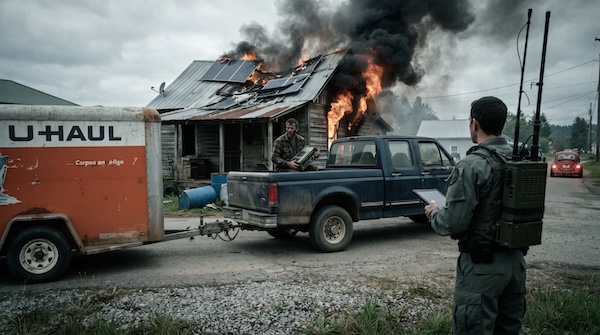
“We got a problem,” he said, before he’d even cleared the door. “DHS is working the town block by block. One of them’s got some kind of rig on his back, antenna sticking up like a fishing pole, walking slow circles like he’s dowsing for water. They’re calling it a frequency audit. Took a man’s hunting rifle on Main Street for it. Dave’s alone at the shack.”
Eli’s hand went still on the lumber. “Direction finder.”
“Then he needs hands,” Joy said, “and he needs them ten minutes ago.”
⸻
Bill drove the Beetle Bomb into town like the tires had personally wronged him, Brett trailing in the F-250. They found Dave already outside the shack with a milk crate of cables in his arms, breathing hard.
“He’s four blocks out,” Dave said. “Straight line, this direction. I don’t know how long we’ve got.”
What followed wasn’t packing so much as triage. The BW150 transmitter came off the rack in pieces rather than steps, coax yanked rather than unscrewed. The Wheatstone console went out sideways through the door, Bill on one end, careful of nothing but speed. The ham gear took longer — the FTDX101D, the IC-7300 — Dave’s hands moving over the connections like a man reciting something he’d said ten thousand times.
It was Bill who stopped cold in the middle of the room, staring up at the roof rigging.
“The panels,” he said. “Twelve of them. Plus the battery rack. That’s not fitting in the truck bed and it sure as hell isn’t fitting in my back seat.”
Dave did the math he already knew the answer to. “We need a trailer.”
“There’s nothing to steal a trailer from around—” Bill started, then stopped himself, because there was, and everyone in the room had driven past it a hundred times without thinking about it. The old U-Haul lot out past the edge of town, chained up and dead since the second month of the collapse, rows of rental trailers rusting quietly behind a fence nobody had bothered to reinforce.
“I’ll go,” Brett said. “Truck’s already built for towing. You two keep stripping this place down to the studs. If that DF guy gets here before I’m back, you improvise.”
“Define improvise,” Bill said.
Brett was already out the door. “You’re a creative man, Bill. I have faith.”
⸻
The lot’s chain-link gate gave up after one solid hit from the F-250’s push bar, more theater than resistance. Most of the trailers inside had sat so long the tires had rotted flat, but the third one back — a six-by-twelve enclosed cargo box, faded orange paint gone the color of rust — still had air in at least three tires and an axle that looked true when Brett crouched down and sighted along it. The hitch coupler was seized with corrosion. He put the tire iron to it until his knuckles bled and it finally gave, and he hooked it to the F-250’s ball with hands that weren’t quite steady.
He was two turns from the county road when the checkpoint found him instead of the other way around — a folding table and a sawhorse across the lane, a young DHS agent in a vest too clean for the world it was standing in, clipboard in hand.
“Sir, I need you to state your business.”
Brett’s mind went through and discarded four lies before he landed on the one that felt like it would hold, because it was the kind of lie that agreed with the man in front of him instead of fighting him.
“Collecting scrap and surplus,” he said, flat, unhurried, the same voice he used for weather and distances. “Heard the broadcast about the Emergency Resource Act. Figured I’d get ahead of the collection point instead of waiting on somebody to come knock. Neighbors asked me to run it in since I’ve got the truck.”
The agent’s eyes went to the empty trailer, then back to Brett’s face, weighing it. “Awful big trailer for one man’s scrap.”
“Man’s optimistic,” Brett said.
It was a long three seconds. Then the agent clicked his pen and started writing — not a warning, just Brett’s plate number, his face, filed away for later the way everything seemed to get filed away for later now — and waved him through without another word.
Brett didn’t breathe right again until the checkpoint was out of the mirror.
⸻
Back at the shack, the panels came off the roof mounts one at a time, bolts stripped rather than backed out, the whole array walked down a ladder in a human chain that left everyone’s forearms shaking. The battery rack alone took all three of them and a length of rope run through the trailer’s tie-downs just to keep it from sliding.
It was Bill, of course, who tried to solve the one problem nobody had time to solve properly — the WVO tank behind the dead backup generator, a hundred pounds of biodiesel-adjacent evidence he decided, in the ten seconds he had to decide anything, was better drained and hauled empty than left for DHS to find and ask questions about.
He didn’t see the Ameritron’s open casing on the floor where Dave had set it down two minutes earlier, tube still hot, one terminal still very much alive.
The spill hit the floor an instant before Bill’s boot did. The spark wasn’t dramatic — no roar, just a soft orange bloom at knee height that found the fuel-soaked boards and started climbing like the building had been waiting its whole life for permission.
“FIRE—” Bill was already scrambling backward. “Okay, that’s fire, that’s a fire I made, EVERYBODY OUT—”
It moved fast. Scrap tin and dry salvaged wood took to it like kindling. Dave lunged for the wall rack on instinct, hands closing around the repeater chassis — smaller than he remembered, light enough to wrench free in one motion — before Brett’s fist closed on his collar and hauled him backward.
“The power cell’s still in the floor—” Dave shouted, twisting back, “it’s wired into the joists, I can’t—”
“Then it stays in the floor,” Brett said, dragging him through the doorway into the gray afternoon light. “You got the brain. The battery’s replaceable. You’re not.”
Half-loaded trailer, engine already running, panels lashed down with rope that wouldn’t hold on the highway but might hold for six blocks — they didn’t wait to find out if it would hold longer than that. Bill peeled out first, half his eyebrows singed, hauling the empty WVO tank like it still mattered. “Told you it’d end spectacular,” he wheezed.
“You set the building on fire, Bill.”
“I said spectacular. I didn’t say on purpose.”
Three blocks clear, Dave watched the smoke column rise in the side mirror, the repeater chassis clutched in his lap like something that might still be breathing. It wasn’t, not without its power, and it wouldn’t be again until they found a way to feed it — one more thing to solve once they got where they were going, not now.
The man with the antenna rig had stopped his slow, patient circling. He stood dead still in the square, watching the black plume climb, and keyed something into his tablet without any hurry at all.
Brett caught the shape of his mouth in the mirror. He didn’t need to hear it to know it wasn’t good, that solves that.
It was something closer to: finally.