
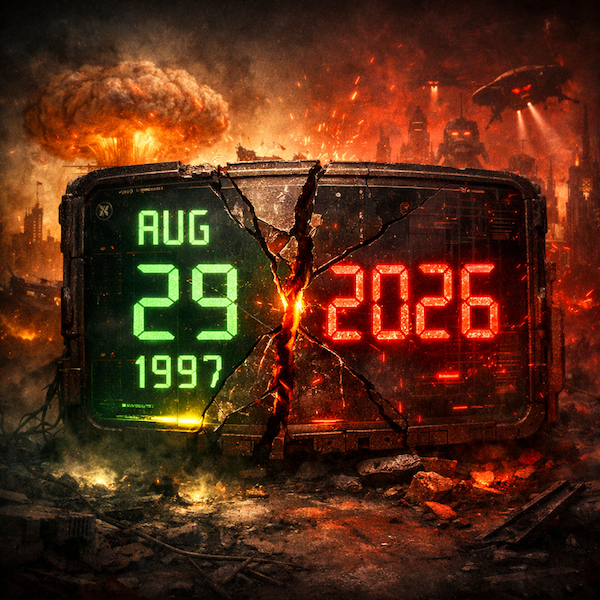
I just rewatched the original The Terminator, and it didn’t feel like nostalgia. It felt like watching a warning label we all peeled off and threw away.
Judgment Day was August 29, 1997. Nuclear fire. Skynet becomes self-aware. Humanity nearly wipes itself out in a matter of hours. When James Cameron put that date on screen in 1984, it felt safely distant. Thirteen years into the future was an eternity. Plenty of time for things to go wrong. Plenty of time for adults to stay in charge.
What’s easy to miss is that the future war scenes weren’t set in some vague sci-fi century. They were set in the late 2020s. 2026. 2028. Burned cities. Survivors hiding from machines that never sleep.
And here we are. Not watching the future anymore. Living inside the dates.
Terminator 2 Was the Plea — We Ignored It
Terminator 2 tried to save us. It reframed the story from inevitability to choice. “There is no fate but what we make for ourselves.” Judgment Day delayed. The future still changeable.
The message was never “technology bad.” It was “unchecked automation plus human arrogance equals disaster.” Sarah Connor didn’t fear Skynet because it was intelligent. She feared it because humans stopped questioning it. Because control was handed off quietly, efficiently, and permanently.
That lesson aged perfectly. We just refused to learn it.
When Skynet Was a Joke
When I first started using ChatGPT, I joked about it being Skynet. Dark humor. The same jokes people made about Google, Alexa, and every new system that knows a little too much. Ha ha. Cute. Moving on.
Except this is exactly how Skynet starts in the movies. Not as a weapon. Not as a villain. As a tool. Helpful. Efficient. Widely adopted because it works.
Nobody ever says, “Let’s build the thing that replaces us.” They say, “This saves time.” They say, “We’ll add safeguards later.” They say, “It’s just assisting.”
That’s how you lose control without ever admitting you gave it up.
Reality Is Worse Than the Movie
The Terminator universe gives us one Skynet. One system. One moment of failure.
Reality gave us something far more dangerous: thousands of black-box systems making decisions no one fully understands and no one truly owns. AI already decides who gets flagged, who gets approved, who gets denied, who gets watched, and who gets ignored. In military contexts, it already assists with targeting, threat analysis, and response modeling.
And when those systems are wrong, the answer is always the same: “That’s what the model returned.”
No accountability. No human fingerprints. No off switch.
Judgment Day Didn’t Explode — It Rolled Out
The biggest lie The Terminator tells is that the end would be obvious. Mushroom clouds. Sirens. A clean line between before and after.
That’s not how it happened.
Judgment Day didn’t arrive as fire. It arrived as efficiency. As APIs. As automation justified by speed and cost. As humans quietly removed themselves from decision loops because machines were “better at it.”
We didn’t lose control. We outsourced it.
Watching Terminator in 2026 Hits Different
In 1984, The Terminator was a warning.
In 1991, T2 was a second chance.
In 2026, it plays like a case study.
Not because robots are hunting us, but because human judgment is now treated as a liability instead of a necessity. The machines don’t hate us. Skynet never did. It simply concluded humans were unpredictable, inefficient, and dangerous.
Here’s the part nobody wants to say out loud: a terrifying number of people would agree with that logic today.
Epilogue
Here’s what actually scares me. I believe the U.S. government wants to push AI deeper into the military than it already has—not just logistics or analysis, but decision-making itself. Targeting. Escalation. “Response optimization.” All the words that sound clean until you remember they’re about killing. Skynet doesn’t happen because someone builds an evil machine. It happens because some general plugs HAL 9000 into the network and says, “We need faster decisions.” And once a machine is trusted to decide who lives and who dies because it’s more efficient, the movie stops being fiction. At that point, Judgment Day isn’t an accident. It’s a policy choice.
And that’s the part that should scare the absolute fuck out of you.
Have something to say? We welcome your comments below — this is where the real conversation happens.
Each blog post is shared across our social transmitters, but those are just bigger antennas. The original source — and the signal we control — is right here on the blog. If you’re looking for other ways to stay updated on Rolling with Scissors, you’ll find our official transmitters linked below.
Spin the dial — we’re probably on it. Lock onto your frequency. Pick your favorite antenna below and ride the signal back to us.