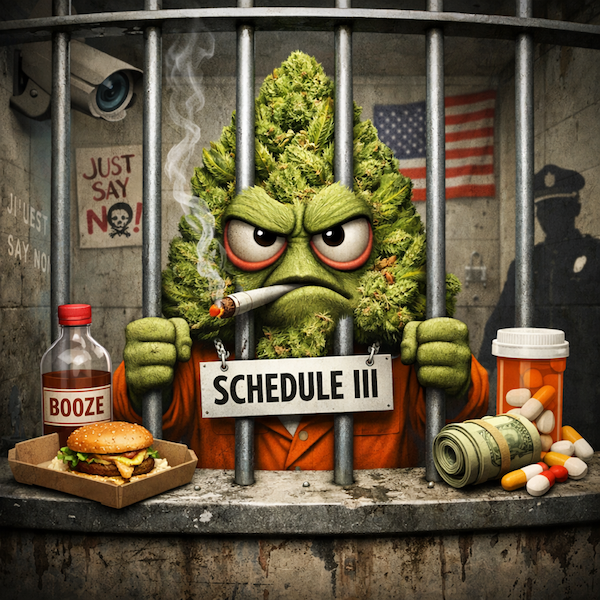
Once again, we’re being told this might be the moment. The federal government may reclassify marijuana from Schedule I to Schedule III. And before anyone rushes in to say “actually, that matters,” yes—it does. This isn’t nothing. Schedule III would mean cannabis businesses can finally work with banks like real businesses instead of operating like a goddamn underground casino. It would mean relief from IRS code 280E, which has treated licensed dispensaries like criminal enterprises for decades. It would mean fewer cash-only storefronts, fewer armored cars, fewer absurd workarounds that exist solely because the federal government refuses to admit reality.
That part is real. That part is progress. And it’s long overdue.
But don’t confuse that with acceptance. And don’t confuse it with legalization. Because this country is very good at doing just enough to look reasonable while refusing to finish the job.
What Schedule III Fixes—and What It Won’t
Moving cannabis to Schedule III is the federal government finally admitting marijuana has medical value. That’s the big confession. It makes research easier. It fixes some of the most punitive tax insanity aimed at cannabis businesses. It allows banks to get involved without acting like they’re laundering cartel money.
What it does not do is make cannabis federally legal. It does not override state laws. It does not fix interstate commerce. It does not guarantee permanent protection from federal enforcement. It does not erase criminal records or undo decades of damage done in the name of the drug war.
In other words, it cleans up some of the most indefensible bullshit while leaving the core contradiction intact. That’s not resolution. That’s the federal government slowly backing away from a lie it can no longer defend.
The States Already Moved On
At the state level, this argument is over whether Washington likes it or not. Twenty-four states and Washington, D.C. have legalized cannabis for recreational use. Roughly forty states allow some form of medical marijuana. That’s not fringe behavior. That’s the majority of the country.
People buy weed legally. They pay taxes. States fund schools and infrastructure with cannabis revenue. Dispensaries operate under tighter regulation than most bars. This is not chaos. This is governance.
And yet federally, marijuana is still treated like a moral crisis. That disconnect is why every incremental federal move gets hyped as historic. Washington isn’t leading. It’s being dragged forward by a country that already made up its mind.
We Knew This Was Stupid Decades Ago
This isn’t new insight. Madison and Dane County were effectively decriminalizing cannabis back in the late 1970s. Not legalizing it. Not endorsing it. Just quietly acknowledging that ruining lives over weed was pointless.
The attitude was simple: don’t be an idiot, don’t cause problems, go home.
That was nearly fifty years ago. People who thought legalization was inevitable back then weren’t naïve. They were responding to reality. What they underestimated was how committed the federal government is to clinging to a bad decision long after it’s been proven wrong.
Why Federal Acceptance Keeps Hitting a Wall
Here’s the part that actually explains everything. Cannabis isn’t federally accepted because drug policy in the United States has never been about health or safety. It’s been about morality signaling.
In large parts of the country—especially the Bible Belt—“drugs are bad” isn’t a policy stance, it’s an identity. It doesn’t matter that alcohol kills people. It doesn’t matter that opioids wiped out entire communities. Weed is still treated as the line between “good” and “bad” Americans.
National politicians know this. They’re terrified of being labeled “soft on drugs,” so federal reform always comes wrapped in caution tape. Incremental. Conditional. Fragile. Enough to look busy, never enough to actually close the loop.
Follow the Money, Especially the Booze
Then there’s the alcohol industry. Alcohol has enjoyed a government-protected monopoly on legal intoxication forever. Cannabis wasn’t a problem when it was theoretical. It became a problem the moment it became competition.
In Wisconsin, this isn’t subtle. The Tavern League has fought cannabis legalization relentlessly for years. And yes, they’d lose money. But here’s the part they don’t like admitting: they’re losing money anyway. People don’t go to bars like they used to. That’s culture changing, not cannabis destroying society.
Instead of adapting, they’d rather keep another industry illegal and pretend it’s about public safety. It’s not. It’s about protecting a monopoly that’s already cracking.
The Drug War’s Favorite Lie
What makes all of this unbearable is the hypocrisy. Drugs are bad—except alcohol, which we celebrate. Drugs are bad—except prescription opioids, which were aggressively pushed with regulatory approval until entire regions were destroyed.
OxyContin wasn’t an accident. It was a business model. Regulators signed off. Doctors prescribed it. Corporations made billions. And tens of thousands of people died every year. In recent years, opioid overdoses have killed roughly eighty thousand Americans annually, making up the vast majority of all drug overdose deaths in the United States.
That devastation was treated as a tragedy, a public health crisis, something we needed task forces and settlements and white papers to address.
Cannabis, meanwhile, is treated like a moral threat—despite the fact that there is no credible evidence of fatal overdose from cannabis itself. We can’t point to a documented body count from weed the way we can with opioids. Cannabis doesn’t shut down your breathing. Opioids do.
And yet federal law still clings to the fiction that marijuana belongs in the same conversation as drugs that kill people by the tens of thousands.
Why I Don’t Believe Full Legalization Is Ever Coming
Here’s where I stop pretending optimism is warranted. I don’t think we’re ever getting full federal legalization. Not cleanly. Not honestly. Not as long as there are still states that will throw you in jail for the tiniest amount of cannabis—or even a damn seed.
And yes, those places exist. States like Louisiana have historically treated minor cannabis possession like a serious crime long after other states figured out how stupid and cruel that is. This isn’t ancient history. It’s policy being enforced now by people who claim to care about life, morality, and freedom.
People Have Died Over This
If you think that sounds dramatic, remember this: a quadriplegic man named Jonathan Magbie was jailed for a marijuana offense and died in custody after being denied the breathing support he needed to survive. A human being—paralyzed from the neck down—left to die over weed.
That happened in the United States. Not a hundred years ago. Not in some authoritarian dystopia. Here.
So forgive me if I don’t clap when the federal government announces a partial retreat from an indefensible position. Forgive me if I don’t believe the system that allowed that to happen is suddenly going to grow a conscience.
Almost Legal Is the Ceiling
Yes, Schedule III matters. It fixes real problems. It makes cannabis businesses safer. It reduces some of the sheer stupidity baked into federal policy. I’m not dismissing that.
But it’s not justice. It’s not acceptance. And it’s not the end.
It’s another chapter in the long American tradition of cannabis being almost legal. Close enough to admit reality. Not brave enough to own it.
I’ll believe this moment means something when it’s finalized, implemented, survives the lawsuits, and doesn’t get walked back the next time someone decides to run on “law and order.” Until then, yeah—almost legal. I’ve heard that before.
Have something to say? We welcome your comments below — this is where the real conversation happens.
Each blog post is shared across our social transmitters, but those are just bigger antennas. The original source — and the signal we control — is right here on the blog. If you’re looking for other ways to stay updated on Rolling with Scissors, you’ll find our official transmitters linked below.
Spin the dial — we’re probably on it. Lock onto your frequency. Pick your favorite antenna below and ride the signal back to us.
Facebook • Instagram • Threads • Bluesky • X (Twitter)
0 Comments