I don’t talk about sports very often.
And if I’m being brutally honest, it’s not because I don’t have opinions — it’s because sports were never built with people like me in mind to begin with.
When you grow up disabled, sports aren’t something you do. They’re something you’re parked in front of.
You sit on the sidelines in gym class.
You keep score.
You hand out water bottles.
You become part of the support staff of your own childhood.
So yeah — I never played. Balance issues, mobility limitations — it just wasn’t happening. And after a while, you stop paying attention to a world that never made space for you in the first place.
But here’s what’s been boiling over for me lately — because disabled sports absolutely exist, and they’re not some watered-down, feel-good recreation league version of athletics.
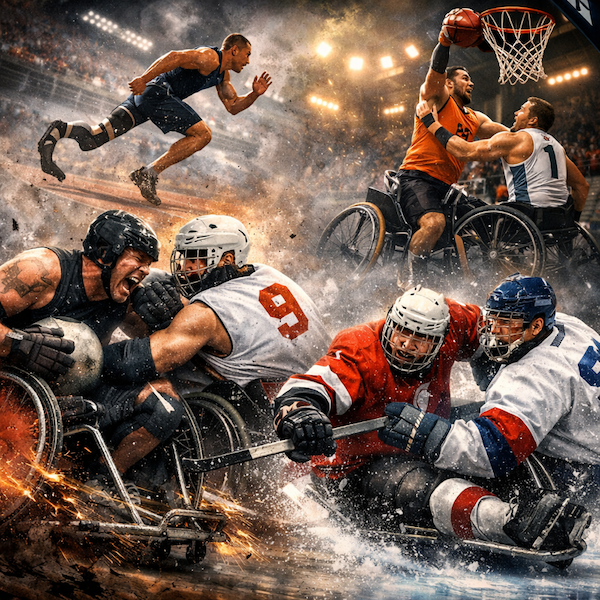
We’re talking elite-level, full-contact, break-bones-and-shatter-ego competition:
Wheelchair rugby — nicknamed murderball for a reason.
Wheelchair basketball — fast, tactical, and brutal.
Sled hockey — blades, boards, and full-speed collisions.
These athletes train like professionals because they are professionals.
They wreck their bodies.
They rehab injuries.
They sacrifice time, money, relationships — everything it takes to compete at the highest level.
And yet?
Unless you’re already inside the disabled community, you don’t hear a damn thing about any of it.
No highlight reels.
No endorsement deals.
No debate shows arguing stats.
No cultural footprint.
It’s like adaptive sports exist in a locked room the mainstream sports world refuses to open.
And what really twists the knife is this:
There was a moment where I thought that might actually change.
When the documentary Murderball came out years ago, it felt like a door finally cracked open.
Here was wheelchair rugby — raw, violent, unapologetic — thrown directly into the public eye.
No pity narrative.
No soft lighting.
No inspirational violin soundtrack.
Just athletes smashing into each other at full speed, talking shit, competing like warriors.
It showed disabled athletes the way they actually are:
Intense.
Competitive.
Human.
And for a minute — a brief, electric minute — it felt like the world noticed.
People talked about it.
Media covered it.
Audiences were shocked — in a good way — to realize adaptive sports weren’t therapy sessions on wheels.
I remember thinking: Finally. This is the turning point.
This is where adaptive sports stop being hidden.
This is where coverage expands.
This is where networks realize there’s a real audience for this.
And then…
Nothing.
It faded.
“Oh wow, that was cool.”
“That was inspiring.”
“Good for them.”
And then the cameras went right back to ignoring the entire ecosystem that documentary exposed.
No sustained coverage.
No broadcast expansion.
No cultural integration.
It became a one-off curiosity instead of a catalyst.
Like the world briefly peeked behind the curtain, nodded politely, and then closed it again because it made them uncomfortable to look too long.
And that pisses me off more than if it had never happened at all — because it proved the interest was there.
People watched.
People cared.
People were blown away by the intensity.
But instead of building on that momentum, the sports media machine just… moved on.
Which brings us right back to the Olympics cycle.
Wall-to-wall Olympic coverage.
Prime time.
Every network.
Every streaming platform.
Every social feed flooded with medal counts and national pride.
And then, trailing behind it like an afterthought, come the Paralympics.
Yes — they follow the Olympics, usually about two weeks later, in the same host region, using the same infrastructure. The 2026 Winter Paralympics, for example, kick off in Milan-Cortina in early March, shortly after the Olympic Games close.
Same venues.
Same global athletes.
Same lifetime of training.
But suddenly the broadcast presence drops off a cliff.
You can watch, technically — streaming platforms like Peacock, NBC digital outlets, and the official Paralympics channels carry events.
But you have to go looking for it.
You have to know it’s happening.
You have to dig through apps.
You have to care enough to hunt it down.
Meanwhile the Olympics are shoved in front of your face whether you asked for it or not.
That disparity isn’t accidental — it’s systemic.
Because exposure creates audience.
If you bury Paralympic coverage behind secondary platforms and off-hour broadcasts, of course the ratings will look smaller.
And then networks use those smaller ratings to justify continuing to bury it.
It’s a self-perpetuating invisibility loop.
And the athletes — world-class, elite, brutal competitors — get treated like a post-credits scene instead of the main feature.
And that’s the part that’s infuriating.
Disabled athletes don’t need pity coverage.
They need parity coverage.
Show the hits.
Show the speed.
Show the strategy.
Show the rivalries.
Let kids in wheelchairs see athletes who look like them competing at full throttle — not just appearing in tear-jerker montages about “overcoming adversity.”
Because representation in sports isn’t just inspirational — it’s legitimizing.
It says:
You belong here.
You compete here.
You matter here.
And right now?
That message is still being delivered at half volume — decades after documentaries like Murderball proved the world was ready to hear it louder.
So yeah — this post is pissed off.
Because the skill is there.
The competition is there.
The stories are there.
The spotlight just keeps getting pointed somewhere else.
And it’s long past time that changed.
Have something to say? We welcome your comments below — this is where the real conversation happens.
Each blog post is shared across our social transmitters, but those are just bigger antennas. The original source — and the signal we control — is right here on the blog. If you’re looking for other ways to stay updated on Rolling with Scissors, you’ll find our official transmitters linked below.
Spin the dial — we’re probably on it. Lock onto your frequency. Pick your favorite antenna below and ride the signal back to us.
Facebook • Instagram • Threads • Bluesky • X (Twitter)
0 Comments