
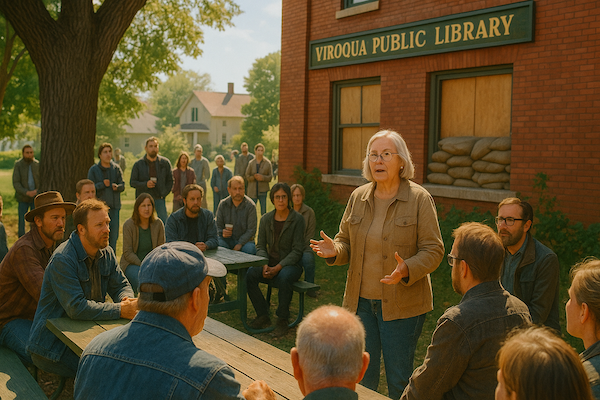
The Viroqua Public Library hadn’t seen this much action since the days of book fairs and school field trips. The town square around it was alive with murmured conversations, clinking coffee mugs, and the unmistakable tension of people trying to make sense of a world that no longer followed rules.
It was just past noon, the time Brett Whyte had said the meeting would start. Bill, Dave, and Cronauer had arrived early enough to secure a spot at a picnic table under one of the few large oaks that still shaded the yard outside the library. The building itself stood strong, though its front windows were now sandbagged and boarded halfway up. Nobody really thought Viroqua would be a target, but after what happened in Madison, “just in case” had taken on a whole new meaning.
Maybe sixty or seventy people had shown up—some on foot, a few on bikes, and a couple in old diesel trucks that still rumbled like tanks. It was more than anyone expected.
“I’ll be damned,” Bill muttered, eyeing the crowd. “Didn’t think this many folks were still around.”
“They weren’t all here last month,” Dave added. “Some of ‘em must’ve come back when the cities turned to hell.”
It was the first public gathering since everything fell apart—and people came not just for answers, but because seeing each other helped confirm they were still real.
At precisely 12:03, Joy Luebke stood up. She didn’t shout. She didn’t wave. She just rose and waited. And like someone had thrown a switch, the noise died down. People turned toward her with a quiet respect that had nothing to do with authority and everything to do with trust.
“Thanks for coming,” she said simply. “I know things haven’t been easy. I also know that the only way we keep this town breathing is by looking out for each other. So that’s what today is about. Not solving everything. Just… checking in, pooling what we’ve got, and maybe finding ways to hold on.”
There were nods. A few people clutched notebooks. Others just watched.
A wiry man near the back—someone Cronauer recognized from earlier—spoke up.
“Not everybody knows what’s going on. I sure as hell don’t. I ain’t got a radio, and half the people I used to check in with are just… gone.”
That opened the floodgates.
Voices joined in, questions piling on. What happened to the food convoys? Why did the internet flicker and then vanish? Were the stories about the Mississippi River traffic true? Was DHS really telling people to hand in ham radios?
Joy let it run for a minute before raising a hand.
“Brett, you’ve been listening. What have you heard?” she asked.
Brett Whyte stood, arms folded, his hat—not quite tinfoil, but close—resting on the bench beside him. “It’s bits and pieces. Military chatter out of the south. Some kind of floating checkpoint on the river, maybe private security or mercs. And yeah—I’ve heard the DHS broadcasts telling folks to turn in civilian transmitters. Haven’t heard if anyone’s listening, though.”
“Why would they want the radios gone?” someone asked.
“Control,” Brett replied flatly. “No comms, no coordination. Simple as that.”
A silence followed. The logic was ugly, but hard to argue.
Cronauer stood.
“For those of you who don’t know me, my name’s Cronauer. Some of you might’ve heard my voice on the air. That wasn’t a fluke. I’ve been working with some friends to bring the old WDRT signal back online. The AM carrier’s already live, and if we can get the right materials, we’ll have FM soon too.”
That got people’s attention.
“But we’re not just bringing music and old broadcasts. We’re trying to give people something we’ve all lost—connection. Information. Maybe even hope. And on that note…” He paused and looked over the group. “There’s a stash of hand-crank radios that were meant to be pledge drive premiums—back when that still mattered. They were never given out. We’re working on getting those into the hands of folks who need them, especially anyone without a way to hear what’s being shared.”
A ripple of interest spread through the crowd. Joy’s eyes locked onto Cronauer’s.
“You said you’ve got an antenna,” she said. “And I happen to have a working receiver. I’ve heard some of what you’ve been airing.”
He nodded.
“We need more than just radios,” Joy added. “We need fuel, clean water systems, clothing, medical supplies, seeds. If you’re serious about using that signal for the town—not just nostalgia—I could use help reaching out to people who might still have those things.”
Cronauer didn’t hesitate. “Let’s do it.”
For the first time that day, the tension lifted just a bit. People weren’t smiling, exactly—but they weren’t as hunched under invisible weight either.
As the meeting wrapped and folks began to drift off in twos and threes, Joy approached the table where the three men still sat.
“Tomorrow,” she said, “I’ll take you up to the ridge. You should see what we’ve got before you promise too much.”
Cronauer nodded.
“I look forward to it,” he said.
As Joy turned and walked back toward the library, Brett sidled up beside her, still muttering about frequencies and bootleg repeaters. Dave elbowed Cronauer lightly.
“Well, I guess we’re in it now,” he said.
Cronauer looked out over the square, then up at the radio tower in the distance.
“We always were.”
Enjoying the story? Signal Drift is unfolding one chapter at a time right here on the blog. Got thoughts, theories, or feedback? Drop a comment below — that’s where the real conversation happens.
Every chapter also beams out through our social transmitters, but if you’ve made it this far, you’re already tuned into the right signal.
Want to dive deeper into the world? Meet the characters of Signal Drift — and keep an eye on that page, because it’ll evolve as the story does.
Spin the dial — we’re probably on it. Lock onto your frequency. Pick your favorite antenna below and ride the signal back to us.
Facebook | Instagram | Threads | Bluesky | X (Twitter)
0 Comments