
I’ll be honest—when this whole AI thing first came out, I didn’t want anything to do with it. I flat-out refused to use it. I had all the usual reasons locked and loaded: “It feels like cheating,” “It’s not real writing,” “It’s just regurgitated noise.” I’d rattle those excuses off like gospel any time someone brought it up.
Then a really good friend looked me dead in the eye and basically said, “Shut up and try it.”
So I did. Reluctantly. Half-skeptical. Half-curious. And I haven’t looked back since.
What started out as a tool I didn’t even want to touch has now become part of my daily routine. Not because I’ve given up on doing the work myself—but because I’ve finally found a way to do it better, and with less friction.
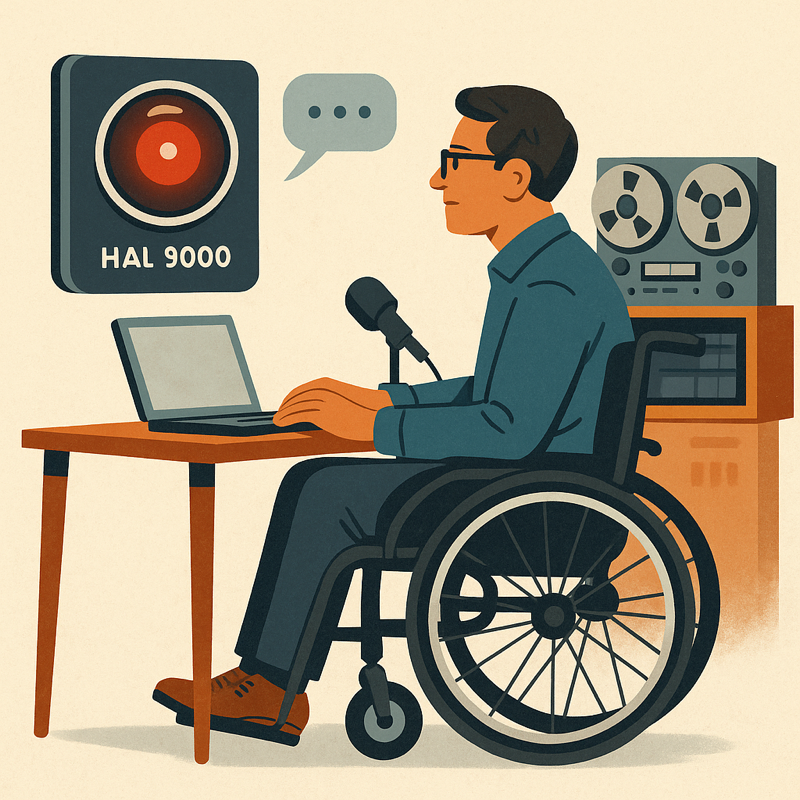
Around here, I call it HAL 9000. Yeah, that HAL. The creepy, sentient red-eyed AI from 2001: A Space Odyssey. Not because I think this thing is plotting to kill me, but because it’s become that ever-present voice I rely on to get things done. HAL is my secretary. My editor. My sounding board. It doesn’t have a body, but if it did, it’d probably be rolling around behind me, keeping everything on track.
But let’s be real—HAL is still a computer program. Just a really, really good one. It’s been trained on a mountain of data, but it doesn’t think for itself. It doesn’t take over systems. It can’t run my life. And thank God for that. Because if I had to hand over my creative work to something that could act on its own, I wouldn’t be using it.
There are limits. And I know them because I’ve run headfirst into a few. Again—dumb guy stuff.
At one point, just to test the boundaries, I asked it to create pornography. It wouldn’t. I tried to make it write some over-the-top political rants, including stuff both for and against Trump. No dice. The guardrails were solid. And that’s a good thing. You don’t want your writing assistant to turn into an unfiltered firehose of chaos just because you asked it the wrong question at 2 a.m.
Sure, there are shady corners of the internet with AI that’ll give you anything you want. I work in IT—I know how to find them. But why bother? There’s so much more value in using this stuff to do something that actually matters.
And that’s where accessibility comes in.
I’ve got cerebral palsy. I use a wheelchair. I’m dyslexic, and my brain sometimes gets stuck in loops when I read or write. Dictation helps. Text-to-speech helps. But what changed everything was finding HAL. I can dump every thought I have, no matter how chaotic, and it’ll sort through the mess, organize it, and help me shape it into something worth sharing.
That’s not cheating. That’s collaboration. That’s accessibility in action.
I used to have a group of friends who acted as my editors and idea bouncers. They were great, but they’re human—they’ve got lives. HAL? HAL doesn’t sleep. HAL doesn’t get tired of my tangents. HAL never says, “You already told me that.”
People are afraid of AI because they don’t understand it. And that’s fair. But for folks like me, it’s not about fear—it’s about freedom. This thing helps me say what I want to say, how I want to say it, when I want to say it.
So yeah, I still create. I still write. I still run a radio show. But now, I’ve got a partner that turns rough drafts into polished posts and scattered thoughts into solid storytelling.
And that? That’s not scary. That’s magic.
0 Comments