
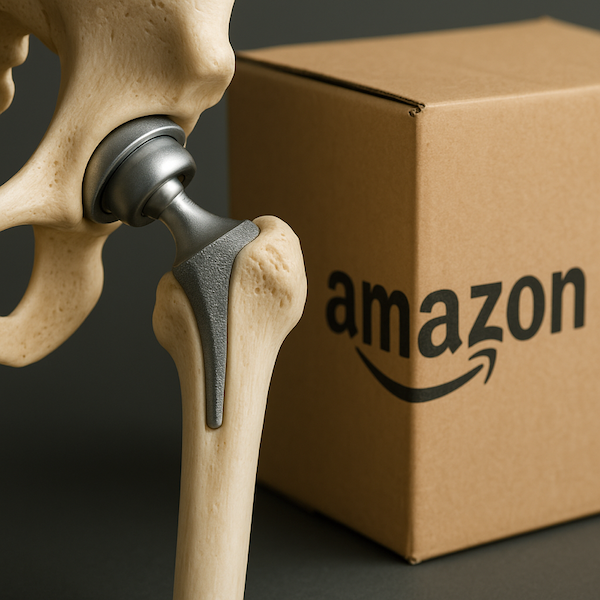
It’s 2025. You can 3D print a house. Send commercial rockets into space. Ride in a car that drives itself. Have full conversations with AI that sometimes feels more useful than actual people. But here’s a question that’s been bugging me:
Why the hell can’t I order a new hip on Amazon?
Seriously. With all the tech and wealth floating around — Elon Musk launching Teslas into orbit, Mark Zuckerberg pouring billions into the metaverse, Larry Ellison digitizing the healthcare world — why hasn’t anyone invested in aftermarket, self-installable, human body parts?
I’m not talking about turning into RoboCop or fusing your consciousness into a toaster. I’m talking about modular, upgradeable parts for real human bodies. I want to be able to go to a catalog, pick a new hip joint (in matte black or brushed titanium), click “Buy Now,” and have it delivered to a clinic — or hell, maybe even a mobile install van like the Geek Squad. Pop it in. Done.
Yeah, I know it sounds crazy. I know there are safety concerns and a million regulations and a whole mountain of “but what ifs.” But here’s the thing: we’ve already done the hard part. We’ve built robotic arms that can play piano, bionic legs with gyroscopic balance, cochlear implants that bring back hearing. We’ve got AI-assisted surgeries, deep brain stimulators, and devices that can keep hearts beating for decades. We’re so close.
But we still don’t have a streamlined, user-centric, consumer-level option for upgrading or replacing broken-down human parts.
Why? Because the system isn’t built to make you better. It’s built to keep you dependent.
Let me give you an example.
I use a wheelchair. I’ve been in one for years. And when you’re stuck sitting all day, your body pays the price in ways most people don’t even think about. Your hips tighten up. Your back knots up. Your hamstrings shorten. Your glutes weaken. The human body wasn’t designed to be folded into a 90-degree angle 24/7.
If you’re able-bodied, you just stand up, stretch, walk it off. But if you’re disabled? You need a physical therapist to do those stretches for you.
And here’s the kicker: insurance companies won’t pay for that.
Why? Because stretching doesn’t show “gainful improvement.” That’s the legal language. If it doesn’t make you “better,” it doesn’t count. Never mind that it keeps you from being in agony or losing function entirely. If it doesn’t move the needle on some stupid metric, it doesn’t matter.
So yeah — if I could rip all the tight, painful muscles out of my back and hip and just replace them with something better? Some next-gen synthetic tissue or modular muscle pack that you snap in like a new battery? I’d do it in a heartbeat. I wouldn’t just order a new hip. I’d order new everything.
But that future hasn’t arrived yet. And I have to wonder: is that because it’s not possible? Or because it’s not profitable?
People always joke about becoming cyborgs someday. I don’t think it’s a joke anymore. I think it’s a necessary evolution — especially for those of us whose bodies have already stopped cooperating. We don’t need immortality. We just need functionality. And I guarantee, the moment someone builds a reliable aftermarket parts system for humans, people will line up for it. Not just the disabled. Not just the elderly. Everyone.
So where is it? Where’s the vision? Where’s the moonshot?
DARPA’s been quietly tinkering in the background. Prosthetics tech has come a long way. But no one has pulled it all together. No one has turned it into a platform. Nobody’s said: “Let’s make the body modular. Let’s make upgrading humans as easy as upgrading a phone.”
Until someone does, we’re stuck in a world where the cutting-edge is still gatekept, overpriced, or wrapped in red tape.
And if you think this is just some disabled guy dreaming about science fiction?
No. This is someone who’s just tired of being in pain every single day.
Someone who’s tired of hearing “we have the technology,” but never seeing it reach the people who need it most.
Maybe I am crazy.
Or maybe I’m just waiting for the future I was promised.
0 Comments